


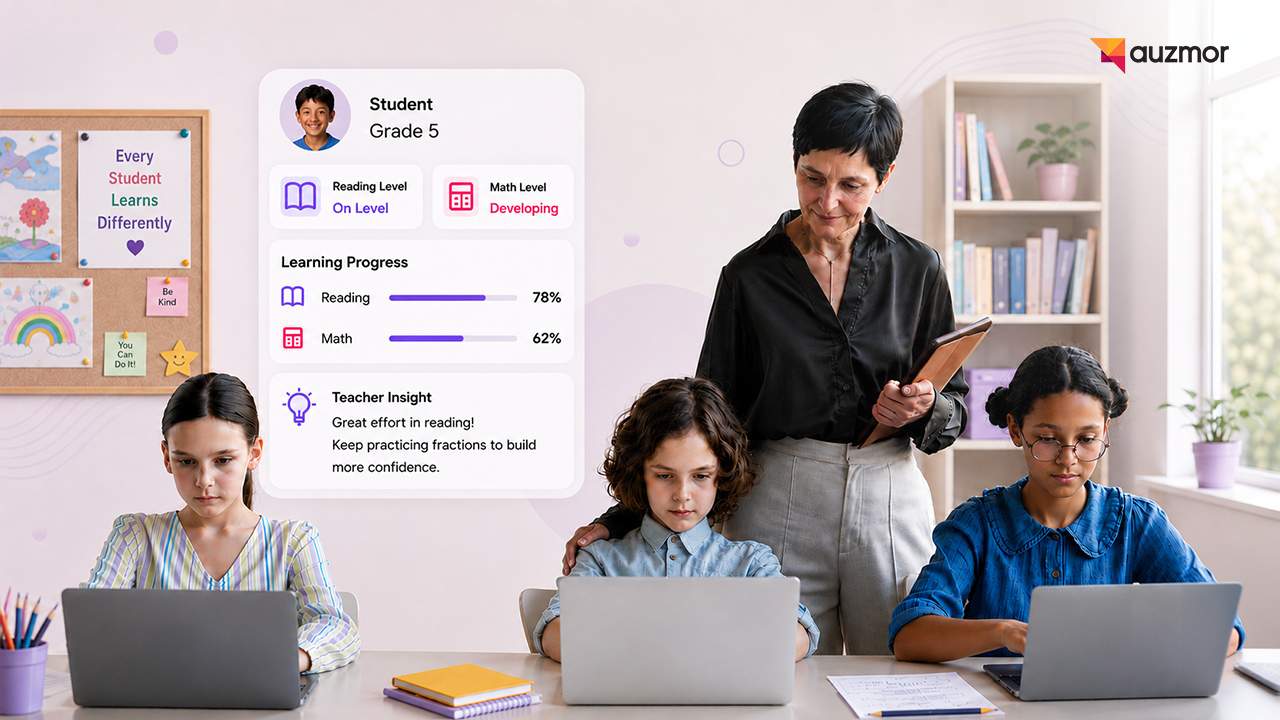
Think about a fifth-grade classroom on any given Tuesday. Twenty-eight kids, one teacher, and roughly twenty-eight different starting points. A few students are reading two grade levels ahead and quietly bored. A few more are still working out multiplication and starting to shut down because they think they're "bad at math." One student just moved from another country and is learning English while also trying to keep up with science vocabulary. Another has an IEP that calls for extra time and different formatting on every assignment. Same room, same lesson plan, wildly different needs.
This is not a rare classroom. It's most classrooms. And it's exactly why adaptive learning has moved from a nice-sounding buzzword to something schools genuinely need. The idea is simple enough: let the technology adjust to the student, instead of forcing every student to adjust to a single, fixed pace. Doing that well at scale, across hundreds or thousands of students, is where a modern learning platform like Auzmor tends to earn its keep, quietly handling the heavy lifting behind a classroom experience that still feels personal.
What "Diverse" Actually Means in a Classroom
When people hear the word diverse, they often jump straight to demographics. That's part of it, sure. But in a classroom, diversity is mostly about learning itself, and it shows up in ways that have nothing to do with background.
There's readiness diversity. Some kids walk in already knowing half the unit. Others are missing a foundational piece from two years ago that nobody caught. There's pace diversity, where one student needs to sit with a concept for a week and another grasps it in ten minutes and needs something harder immediately. There's language diversity, which includes multilingual learners but also just kids who process written instructions differently than spoken ones. And there's the diversity that comes from learning differences like dyslexia, ADHD, or processing disorders, where the content might be right but the format is wrong.
A single lesson plan, no matter how well written, cannot serve all of that at once. Teachers have known this forever. What's changed is that technology can finally help close the gap instead of just adding another task to an already full plate.
How Adaptive Learning Actually Works
Adaptive learning sounds complicated, but the core idea, the same one behind how schools are already using AI to personalize instruction for individual students, is pretty intuitive. Software watches how a student interacts with material, not just whether they got the answer right, but how long they took, where they hesitated, which type of question tripped them up, and it uses that information to adjust what comes next.
Say a student is working through a set of fraction problems. If they keep adding denominators together instead of finding a common one, a good adaptive system doesn't just mark it wrong and move on. It recognizes the specific misconception and offers something different, maybe a visual model, maybe a simpler version of the same idea, before the mistake hardens into a habit. Meanwhile, a classmate who's already fluent in the concept gets nudged toward something more challenging instead of sitting through five more problems they don't need.
This is a genuinely different thing from just digitizing a worksheet. A PDF on a tablet is still a fixed worksheet. It just happens to be on a screen. There's a real difference between a system that passively hosts content and one that actively responds to the learner in real time, and that distinction is worth understanding if you're comparing what separates a traditional LMS from an AI-driven one, since the gap comes down almost entirely to this kind of responsiveness. Auzmor's approach to this leans on exactly that responsiveness, building learning paths that shift based on actual performance rather than a static syllabus that treats every student the same.
Equity, Not Uniformity
Here's a distinction that matters more than it sounds like it should. Fairness in education used to mean giving every student the exact same material, at the exact same pace, in the exact same format. That sounds fair on paper. In practice, it often means the strongest students get bored and the struggling ones get left behind, all while technically receiving "equal" treatment.
Adaptive learning flips that definition. It treats fairness as giving each student what they specifically need to reach the same destination, even if the road there looks different for each of them. A student with dyslexia might need text read aloud and extended time. A student who's ahead might need enrichment material instead of repetition. Neither of those is special treatment in the sense of an advantage. It's just accuracy. You're meeting the student where they actually are instead of where the calendar says they should be.
This matters enormously for multilingual learners too. A system that can present the same core concept with simplified vocabulary, visual supports, or translated instructions isn't lowering the bar. It's removing a language barrier that has nothing to do with whether the student actually understands the math or the science underneath it.
The Teacher Doesn't Disappear, They Get Time Back
There's a worry that comes up a lot with any of this, which is understandable: does adaptive technology replace the teacher? No, and honestly, it can't. What it does is take a genuinely impossible task off a teacher's plate.
Think about what differentiated instruction actually requires without help. A teacher would need to design several versions of every lesson, track individual progress for every student across every skill, and somehow deliver all of that live, in real time, to thirty different kids at once. That's not a realistic expectation for one person, no matter how talented or dedicated they are.
Adaptive systems handle the repetitive part. They track the data, adjust the difficulty, and flag which students need a human's attention right now. That frees the teacher to actually be a teacher: building relationships, noticing when a kid is having a rough week, explaining a tricky concept a different way, and doing the emotional and relational work that no algorithm can touch. The technology handles scale. The teacher handles everything that scale can't fake.
Content That Adjusts, Not Just Difficulty That Adjusts
One thing that gets overlooked in conversations about adaptive learning is that adjusting difficulty is only half the job. The content itself often needs to shift too, not just get harder or easier.
Take a reading passage on the water cycle. A student reading two grades below level might need the same core concept explained with shorter sentences and simpler vocabulary. A student who's ahead might get the same concept with more technical detail and a related question about climate. This is where generative AI for building out training content has become genuinely useful for teachers too, letting them take one source lesson and quickly produce leveled versions instead of writing three or four separate lesson plans from scratch by hand. The same underlying approach schools are exploring for turning source material into multiple content variants is changing how fast a teacher can differentiate a single lesson for an entire room of different readers.
Building the Right Foundation
None of this works well without a solid platform underneath it. You can have brilliant adaptive logic, but if the system delivering it to students is clunky, slow, or impossible for a school IT team to manage, none of that intelligence reaches the kids who need it.
This is really where the conversation about learning platforms becomes practical rather than theoretical. Understanding what a learning management system is actually meant to do, beyond just hosting videos and quizzes, helps schools and districts ask the right questions when they're evaluating tools. It needs to track individual progress cleanly, support multiple content formats, and integrate the kind of adaptive logic described above without requiring a computer science degree to configure. Auzmor's learning ecosystem was built with exactly this kind of scale in mind, giving administrators a way to manage adaptive pathways for large groups of students without the operational mess that usually comes with "personalization at scale."
Bringing It All Together
Diverse classrooms aren't a problem to be solved so much as the actual, permanent reality of teaching. Every room full of students has always contained a wide range of readiness, pace, and need. What's new is that we finally have tools capable of responding to that range instead of ignoring it in favor of a single average pace that serves almost nobody perfectly.
Adaptive learning, done well, doesn't replace good teaching. It supports it, catching the small misconceptions before they calcify, giving advanced students room to keep growing, and giving struggling students the specific help they need instead of a generic worksheet. Platforms like Auzmor exist to make that kind of responsiveness manageable at a real school's scale, not just a nice idea in a pilot classroom of twelve kids. Get the foundation right, and a diverse classroom stops being a logistical headache and starts being what it always should have been: a room full of individual learners, each one actually being taught.