Why L&D Leaders Need an AI Dashboard in 2026

Nick Reddin
ai dashboard learning development leaders
If you run L&D at any company with more than a few hundred people, you already know the feeling. You have a learning management system telling you who finished what course. You have a survey tool telling you if people liked it. You have a spreadsheet somewhere, probably built by someone who left the company two years ago, that tries to tie training back to performance. None of these systems talk to each other. And every quarter, you end up manually stitching together a story for leadership that is really just a best guess dressed up in a nice slide deck. That approach is running out of road. In 2026, the pace of skill change, the pressure to prove ROI, and the sheer volume of learning activity happening outside the LMS have made the old patchwork of reports unworkable. What L&D leaders actually need now is a single AI dashboard that pulls all of this together and tells them, in something close to real time, what is working and what is not. This is exactly the kind of connective tissue that a modern learning platform like Auzmor is built to provide, quietly sitting underneath the reporting so leaders aren't left guessing.


The Old Way of Tracking Training Doesn't Work Anymore

Let's be honest about what most L&D reporting still looks like. Completion rates. Attendance logs. A satisfaction score out of five. These numbers are easy to pull, which is exactly why they stuck around for so long. But they don't answer the question executives actually care about, which is whether people can do their jobs better now than they could before the training happened. Think about a sales enablement program. You can show that ninety percent of reps completed the new objection handling course. Great. But did close rates move? Did ramp time for new hires shrink? If your dashboard can't connect those dots, you're stuck defending a training budget with numbers that don't actually prove anything. This isn't a new problem, but it's become a much more expensive one. Training spend per employee keeps climbing, and boards are asking sharper questions about where that money goes. A dashboard that only shows activity, not impact, puts L&D in a weak negotiating position every single budget cycle.

What Changed: AI, Skills, and the Speed Problem

A few things happened at once that make 2026 different from even two or three years ago. First, the half life of a skill got shorter. What someone learned in a course last year might already be out of date because of a new tool, a new process, or a new AI feature that changed how the job gets done. Second, learning stopped happening only inside formal courses. It's happening in Slack threads, in mentoring conversations, in quick videos employees record for each other on their phones. Third, AI itself became powerful enough to actually read and interpret all of that scattered activity, instead of just reporting on the narrow slice that happens inside an LMS. Put those three together and you get a situation where the old dashboard, built for a world of scheduled courses and quarterly reviews, simply can't keep up. L&D leaders need something that updates constantly, pulls from more sources than just the LMS, and surfaces what actually matters instead of what's easiest to count. The Data Problem Nobody Talks About Here's the part that rarely gets said out loud. Most L&D teams don't have a technology problem so much as a data format problem. Traditional course tracking speaks in a very limited vocabulary: started, passed, failed. It has nothing to say about what happened during the course, or afterward, when the employee actually tries to apply what they learned. Without richer data flowing in, even the fanciest looking dashboard is just repainting the same shallow numbers in a nicer font.

What an AI Dashboard Actually Does

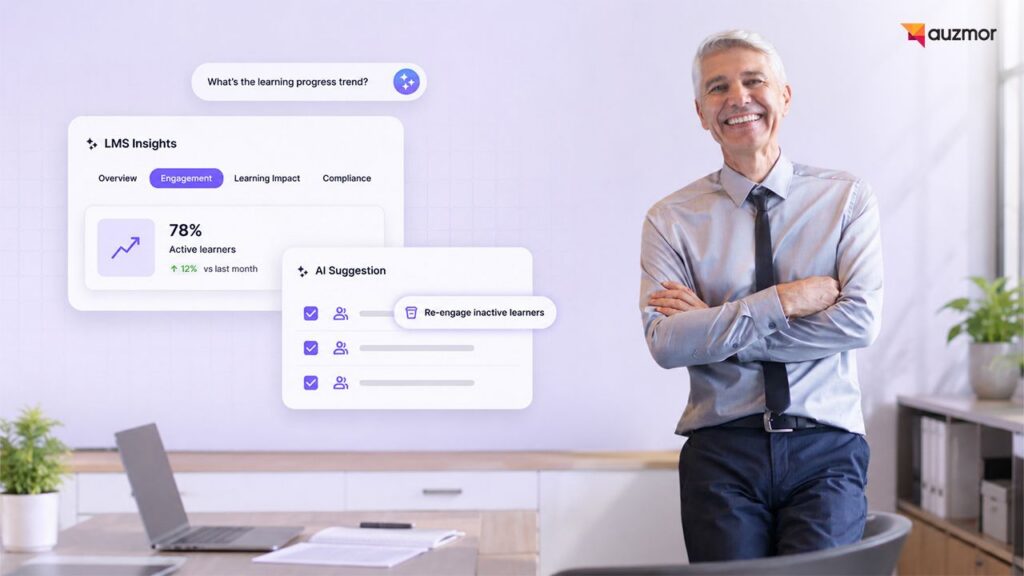
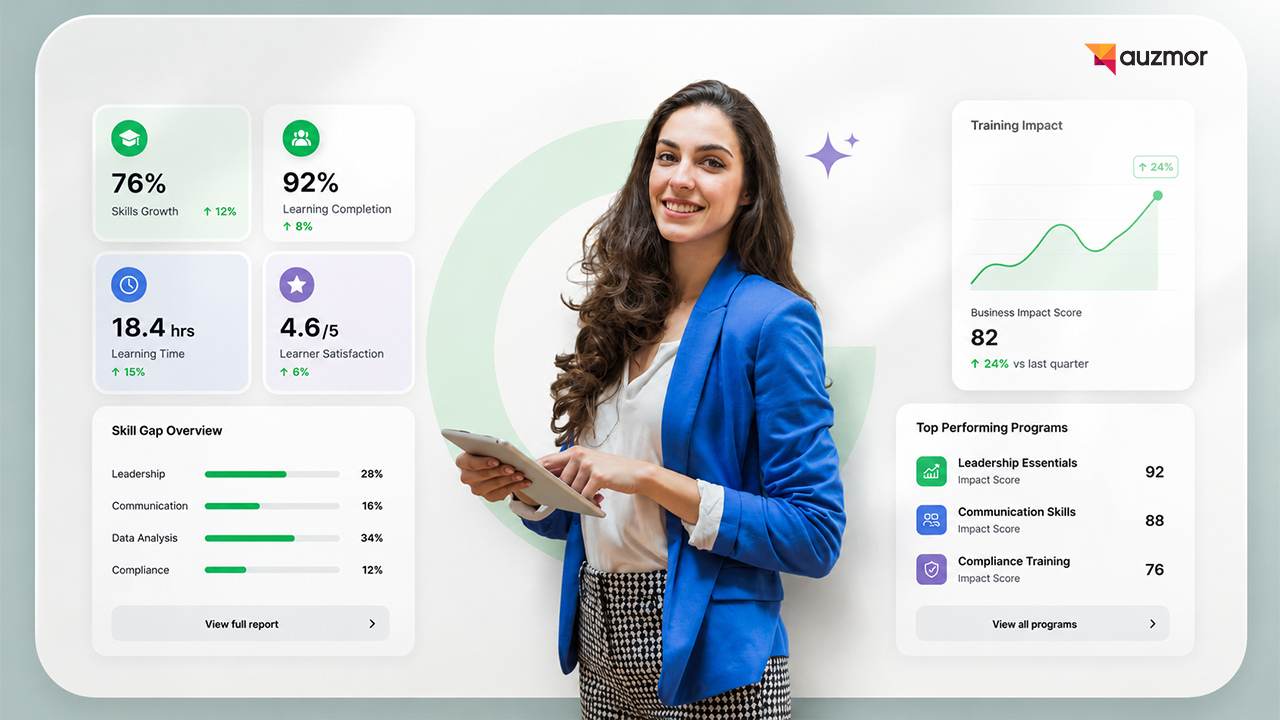
A proper AI dashboard for L&D does three things that spreadsheets and basic LMS reports never could. It infers skills rather than just tracking clicks. Instead of requiring someone to manually tag every course with the competencies it builds, AI can read learner behavior, quiz results, and even job descriptions to figure out what someone actually knows and where the gaps sit. It reads qualitative feedback at scale, which means the thousands of open text comments your team never had time to review actually get analyzed for sentiment and recurring themes. And it flags risk before it becomes a failure statistic, catching the learner who's clicking through slides too fast or bombing every micro quiz, long before that shows up as a missed certification deadline. This is really the heart of the shift from headcount metrics to real skill development that the industry has been having, and it's worth spending real time on if you're building the business case internally. A well built dashboard becomes the connective layer between training activity and the business outcomes your CFO actually cares about, and it's the difference between a report that gets glanced at once a quarter and one that managers actually open every week.

Social Learning Is Part of the Dashboard Story Now

Here's something that often gets left out of the AI dashboard conversation entirely. A huge amount of valuable learning never touches a formal course at all. It's the tip a store manager records on their phone about a display that boosted sales. It's the sales rep who nails an objection and someone captures it on video for the rest of the team. If your dashboard only counts what happens inside official modules, you're missing a large chunk of the picture, sometimes the most useful chunk. This is where AI powered social learning comes in, and it's a bigger deal than most L&D teams give it credit for. When AI can surface, tag, and distribute that peer generated content automatically, it turns informal knowledge sharing into something a dashboard can actually measure. Suddenly you can track things like how often peer content gets reused, or whether new hires who engage with that content ramp up faster than those who don't. That's a data source most L&D teams are sitting on and completely ignoring. Content Creation Feeds the Dashboard Too There's another piece worth mentioning, because it closes the loop nicely. AI isn't just useful for measuring learning after the fact. It's increasingly used to generate training modules straight from a job description, often starting from something as simple as the responsibilities already documented in a hiring requisition. Feed a role's responsibilities and KPIs into a generative model and you can get a structured microlearning outline in minutes instead of weeks. Why does that matter for a dashboard conversation? Because content built this way tends to come with cleaner metadata from the start, meaning the skills a module targets, the KPIs it maps to, are defined up front rather than reverse engineered later. That makes the whole reporting chain, from content creation through completion through actual skill signal, far easier to stitch together. It's one more reason the smartest L&D teams are thinking about content generation and analytics as one connected system rather than two separate projects handled by two separate vendors. What to Look for in an AI Dashboard in 2026 If you're evaluating tools this year, a few things matter more than a flashy interface. Look for a platform that ingests data beyond the LMS itself, ideally supporting richer standards like xAPI so it can capture learning that happens in the flow of work, not just inside a course player. Look for AI that surfaces manager ready insights automatically, rather than dumping raw numbers that someone still has to interpret. And look for a system where content creation, social learning, and analytics live under one roof instead of three disconnected tools that need a data engineer to stitch together. This is essentially the bet Auzmor has made with its learning ecosystem, treating the LMS, the social learning layer, and the analytics engine as one connected experience rather than three separate purchases that happen to share a login screen. For an L&D leader trying to build a dashboard that actually holds up in front of the board, that kind of integration saves months of custom engineering.

The Bottom Line

L&D has spent decades being judged on numbers that were easy to collect but never really proved anything. That era is ending, not because someone decided it should, but because the pace of skill change and the pressure on training budgets made the old approach untenable. An AI dashboard, one that reads skill signals instead of attendance, surfaces peer knowledge instead of ignoring it, and ties content creation to measurement from day one, is quickly becoming table stakes rather than a nice to have. You don't need to build this from scratch, and honestly, most teams shouldn't try. Platforms like Auzmor are already doing the unglamorous work of connecting these pieces so L&D leaders can spend their time on strategy instead of data wrangling. The teams that get ahead of this in 2026 won't just have prettier reports. They'll have an actual answer the next time someone in the boardroom asks if the training is working.  

Related Posts

building trust in ai based lms platforms
LMS
Nick Reddin
August 7, 2026
adaptive learning for diverse classrooms
LMS
Nick Reddin
July 28, 2026

Menu

Compliance training

Become audit-ready

Employee development

Compliance

Sell Training

Customer training

Partner training

training online lms

An all-in-one LMS

Content

Content Marketplace

Custom Content

Auzmor Learn

Get people hooked to learning

Auzmor Office

Unforgettable employee experience

Auzmor LXP

Tailored learning experience

Auzmor Learn

Get people hooked to learning

Content creation

Social learning

Blended learning

Reporting & insights

Mobile app

Extended enterprise

Checklists

E-commerce

Blog

Case studies

White papers

Discover top trends to facilitate smarter business practices

About

Careers

Contact

Support

join auzmor team

Join an innovative team

E-Learning Content

Content Marketplace

Custom Content

Public Sector

On-Premise

Auzmor K12

Auzmor Higher Education