AI Native LMS vs. AI-Enabled LMS: What is the Difference

Nick Reddin
AI Native vs AI Enabled LMS Explained
When we talk about the future of corporate learning, artificial intelligence takes up almost all the oxygen in the room. Every software vendor claims to have an intelligent platform today. But as organizations look closer at what these systems actually do, a massive gap is starting to emerge. That gap is the fundamental difference between an AI-enabled Learning Management System and an AI-native Learning Management System. Understanding this distinction is absolutely critical for anyone trying to build a workforce that can adapt to rapid change. To put it simply, one approach bolts intelligence onto legacy software, while the other builds the entire system around intelligence from day one. When enterprise leaders want to achieve actual business results, they need to look past the marketing hype. They need platforms that are engineered for impact. This aligns closely with our core philosophy at ATC, where we deliver the complete AI solution by combining powerful platform technology with expert delivery services. For mid-market enterprises, this means choosing a path that prioritizes speed, quality, and practical results over unnecessary complexity. Building a solid technical foundation is essential for a strategic approach to enterprise architecture, and that principle applies perfectly to choosing your learning ecosystem. Let us explore exactly how these two approaches differ across architecture, data integration, user experience, and enterprise scalability.


The AI-Enabled LMS: A Traditional House with Smart Devices

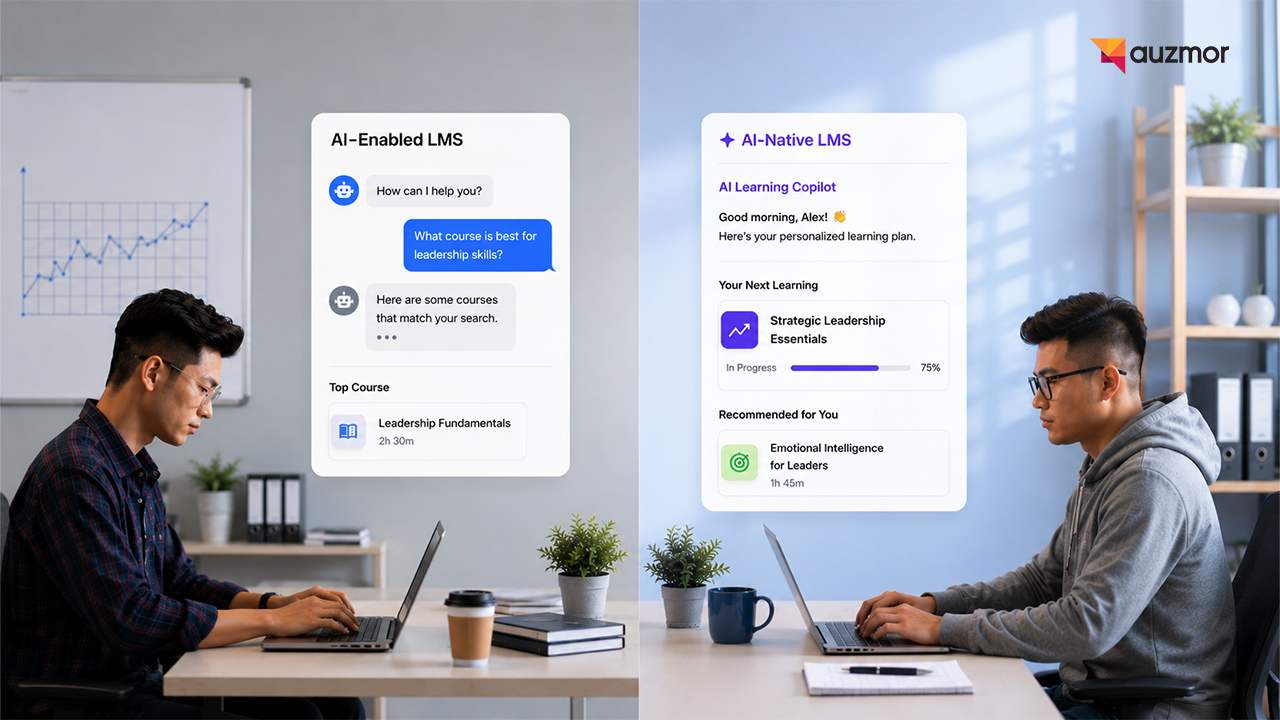
Think of an AI-enabled LMS like an old house that someone just filled with smart speakers and automated light bulbs. The foundation is exactly the same, the wiring is old, and the plumbing has not changed. You just added some modern gadgets on top of it. In the software world, an AI-enabled LMS starts with a traditional learning platform. The core structure revolves around manual workflows, static learning paths, and rule-based reporting. To keep up with current technology trends, the vendor layers AI features on top of this legacy architecture. They might add a chatbot that answers basic administrative questions. They might include a standalone content generator that helps instructional designers write course descriptions a little bit faster. These features can certainly improve efficiency in small ways. However, they rarely change how learning functions on a day-to-day basis. The fundamental logic of the system remains highly course-centric. Learners still follow predefined paths, and administrators still spend hours configuring tedious enrollment rules. The intelligence operates in total isolation because the system was never designed to let data flow continuously between different modules. Data integration in an AI-enabled system is often a major headache for IT teams. Because the core platform was not built for complex machine learning workloads, connecting the AI features to your enterprise data usually requires manual extraction and transformation. The data is pulled, cleaned, and fed into the AI periodically. This means the system is always reacting to old information rather than adapting in real time. If your company needs to pivot quickly, a bolted-on solution will constantly struggle to keep up.

The AI-Native LMS: Built for Intelligence

Now, imagine a house designed from the ground up to be a completely smart ecosystem. The sensors are built into the walls, the heating system talks to the windows, and everything adapts naturally to how you actually live. That is what an AI-native LMS looks like. An AI-native LMS does not ask where it can add artificial intelligence. Instead, it assumes AI is the foundational core of the infrastructure. These systems are intentionally built to support continuous data ingestion, sharing, and learning at every single layer. Rather than treating AI as a separate novelty feature, the platform uses machine learning and large language models to orchestrate the entire learning experience. This requires a completely different technical foundation. AI-native environments incorporate robust data pipelines and model lifecycle management from the very beginning. If you are exploring how to implement this kind of architecture, you need comprehensive tools that do not box you in. This is precisely where the ATC Forge Platform shines. By offering agent orchestration, over one hundred built-in accelerators, MLOps, LLM Ops, and built-in governance, the platform gives you the power to deploy on any cloud. You completely avoid vendor lock-in and scale your operations with total confidence. Managing these continuous feedback loops is a critical part of scaling machine learning operations, ensuring that your models get smarter rather than degrading over time. In an AI-native system, skills are continuously inferred from user activity rather than being manually tagged by human administrators. The platform connects naturally with the broader work ecosystem, including your HR systems, performance tools, and daily collaboration software. The development paths adjust dynamically based on behavior, role changes, and real-time business needs. It represents a fundamental shift from simply distributing content to actually building verified workforce capabilities.

Comparing the Core Differences

To truly appreciate the gap between these two systems, we need to look at how they handle specific enterprise requirements. Let us break down the comparison into three critical areas. Data Integration and Architecture As we touched on earlier, architecture dictates capability. In an AI-enabled system, you are constantly reconciling data formats from multiple sources. You bridge existing data silos with new AI components, which requires continuous data engineering effort just to keep things running. Updates to the machine learning models are often a highly manual process or rely on periodic vendor patches that might not align with your internal schedules. Conversely, an AI-native platform thrives on continuous context. The system development pipeline is designed to continuously apply machine learning to new data. It handles data drift automatically and maintains a constant, secure feedback loop. Every time a user interacts with the platform, the system gets slightly smarter and more aligned with the specific language and goals of your organization. The User Experience If you log into an AI-enabled LMS, the experience feels very familiar and somewhat rigid. You see a catalog of courses, a list of assigned training modules, and maybe a little chat window sitting in the corner. If you are a senior engineer or a brand new hire, you might be assigned the exact same material at the exact same pace. The system cannot tell what you already know, so it treats everyone like a blank slate. An AI-native experience feels entirely different because it is hyper-personalized. The platform stays present in the flow of work. Instead of forcing you to sit through a lengthy, one-off training event, it might answer a technical question using your company's internal knowledge base. It recommends the next relevant module based on the exact skills you are actively trying to develop. It provides short, spaced practice sessions to reinforce knowledge precisely when you need it. The focus shifts from merely completing courses to actually activating knowledge in the real world. Enterprise Scalability Scalability means different things to different platforms. For an AI-enabled system, scaling usually just means adding more user licenses or hosting larger video files. But as the complexity of your workforce grows, the operational burden on your administrators becomes overwhelming. They have to manually update skill paths, manage incredibly complex rule sets, and generate manual reports to figure out if the training actually worked. An AI-native LMS scales intelligence, not just storage capacity. As you add more users and more data, the automated workflows become significantly more accurate. The platform handles the heavy lifting of identifying skill gaps, matching roles to necessary competencies, and generating adaptive assessments. It gives enterprise leaders clear, real-time visibility into what skills exist in the organization and what is critically missing. The administrative effort reduces dramatically because the system optimizes itself.

Why This Shift Matters for Workforce Development

You might be wondering if this architectural difference really matters for your day-to-day operations. To be completely honest, it changes absolutely everything about how an organization grows and stays competitive. Workforce development today is no longer about pushing mandatory compliance courses and checking boxes. It is about enabling your people to build skills quickly and apply them directly to their daily work. We often see companies struggle because their development programs are entirely periodic and reactive. A manager realizes a team lacks a specific technical skill, so they request a training course. Instructional designers then spend weeks or even months building it. By the time the course is finally deployed to the team, the underlying technology or the business requirement has already shifted. It is a frustrating cycle for everyone involved. AI-native platforms solve this exact problem beautifully. They enable rapid iteration and continuous skill development.Because generative features are built directly into the core, the system can create fresh, highly relevant learning content from a simple prompt in minutes instead of weeks. More importantly, it can update that content in real time as source materials and internal policies change. Furthermore, adaptive assessment ensures that testing is not a one-size-fits-all anxiety trap. The system understands the individual characteristics and learning pace of each employee. It provides real-time feedback so people can see exactly where they have gaps and adjust immediately. This promotes a much more inclusive, data-driven, and supportive learning experience. It connects learning directly to performance signals, ensuring that your financial investment in training actually translates to better business outcomes and higher employee retention.

Making the Right Choice for Your Enterprise

The choice between an AI-enabled and an AI-native LMS ultimately comes down to the core problem you are trying to solve. If your requirements are incredibly stable, if your catalog rarely changes, and if you just need to track compliance completions for a yearly audit, a traditional AI-enabled system might do the job just fine. It is a known quantity with modest expectations and a predictable, traditional workflow. However, if your roles shift often, if you need deep visibility into actual workforce capabilities, and if you want to connect employee development directly to measurable business results, an AI-native system is the only logical choice. You simply cannot build a future-proof workforce on a platform that treats intelligence as a bolted-on afterthought. Transitioning to this new model takes thoughtful effort, and it requires a partner who knows exactly how to navigate the complexities of modern architecture. This is exactly where ATC AI Services can guide you. We provide end-to-end support from initial strategy discussions all the way to final production. Our expert teams will walk you through careful assessment, rapid proof-of-concept development, and full enterprise deployment, all backed by our 24/7 managed operations. With a project success rate of over 90 percent and a time to production that is two to three times faster than industry averages, we ensure complete knowledge transfer and highly transparent costs. Finding the right path involves careful planning and practical enterprise deployment, but the results are entirely worth the initial investment. By choosing an AI-native foundation, you are not just upgrading your software licenses. You are fundamentally transforming how your entire organization learns, adapts, and competes in the modern business space.

Related Posts

Menu

Compliance training

Become audit-ready

Employee development

Compliance

Sell Training

Customer training

Partner training

training online lms

An all-in-one LMS

Content

Content Marketplace

Custom Content

Auzmor Learn

Get people hooked to learning

Auzmor Office

Unforgettable employee experience

Auzmor LXP

Tailored learning experience

Auzmor Learn

Get people hooked to learning

Content creation

Social learning

Blended learning

Reporting & insights

Mobile app

Extended enterprise

Checklists

E-commerce

Blog

Case studies

White papers

Discover top trends to facilitate smarter business practices

About

Careers

Contact

Support

join auzmor team

Join an innovative team

E-Learning Content

Content Marketplace

Custom Content

Public Sector

On-Premise

Auzmor K12

Auzmor Higher Education