What Is Cross Trained Workforce Strategy in 2025?

Nick Reddin
cross trained workforce
In a rapidly changing economy, adapting the workforce has become a top concern for leaders. What does cross training mean in 2025? It’s not just a trend it’s essential for business. Seventy-three percent of companies with cross-trained employees report 40% higher productivity in 2025. Remote and hybrid work have revealed skill gaps like never before, showing the drawbacks of isolated job roles. Modern cross-training isn’t just about backup. It’s a competitive edge that fosters resilience, innovation, and employee growth in a technology-driven world.


What Is a Cross-Trained Workforce Strategy?  

So, what is cross trained in the work dynamics of 2025 A cross-trained workforce strategy gives employees multiple related skills beyond their primary job roles. In 2025, this involves matching diverse skills with the needs of hybrid work models, AI integration, and flexible business goals. Unlike traditional job shadowing, which is often informal and reactive, cross-training in 2025 is structured, strategic, and scalable. It focuses on proactive skill development to promote agility, reduce reliance on new hires, and improve internal mobility. In today’s landscape, what is cross trained? Cross-training highlights how quickly an organization can adjust to disruptions through retained knowledge, empowered teams, and talent ready for innovation. The 2025 Cross-Training Evolution   Cross-training has shifted from a temporary solution to a forward-looking talent strategy. From Reactive to Proactive: Organizations are no longer waiting for key employees to leave or positions to open up. They are creating skills redundancy in advance to ensure smooth operations and resilience. Tech-Enabled Learning: With AI-powered platforms, companies can perform skill mapping and create personalized learning paths for every role. This often includes compliance training software​ to ensure employees meet industry regulations while expanding their skill sets. Remote-First Approach: As distributed teams grow, cross-training includes virtual mentoring, video-based learning, and collaborative tools that overcome geographic barriers. Data-Driven Decisions: Cross-training is now monitored and refined with real-time analytics. Businesses can measure ROI, spot skill gaps early, and continuously improve their programs. In short, what is cross trained? It is just a synonym for being prepared for the future.

5 Core Components of Modern Cross-Training Strategy  

Skill Mapping & Gap Analysis  

Begin by creating a digital skills inventory for each role. This helps pinpoint potential gaps, especially those at risk of automation, and establishes a plan for strengthening the workforce. Structured Learning Pathways   Break complex skills into small learning modules and provide just-in-time training that employees can access whenever needed. This boosts retention and scalability. Mentorship Programs   Establish partnerships across departments to promote hands-on experience. Use reverse mentoring to help senior employees learn tech skills from younger colleagues, creating mutual respect and shared knowledge. Performance Tracking   Utilize tools for competency evaluations and progress tracking. This not only helps measure the effectiveness of learning but also allows for refining the training methods. Cultural Integration   It’s essential to have leadership support. Recognize and reward employees who engage in cross-training through internal initiatives or gamified systems. Fostering a learning culture increases participation rates. These elements form the foundation of an effective cross-trained workforce strategy.

Implementation Blueprint for 2025  

Successful cross-training depends on strategic execution. Here’s a four-phase plan designed for 2025: Phase 1: Skills Audit and Priority Identification (30 days)   Start by identifying critical roles and areas at risk of burnout, turnover, or automation. Phase 2: Platform Selection and Content Development (60 days)   Choose an AI-enabled learning management system or cross-training platform. Develop training modules that match current and future business goals. Integrating employee training software at this stage ensures scalability and consistent quality across departments. Phase 3: Pilot Program with Key Departments (90 days)   Test the program in departments like operations, customer success, or IT. Monitor engagement and performance effects, and use this data to improve the approach. Phase 4: Full Rollout with Continuous Optimization   Expand the initiative across the company while integrating feedback loops, performance metrics, and quarterly reviews. Balance quick wins, like improved internal mobility and coverage, with a long-term plan that encourages innovation and workforce stability.

ROI & Success Metrics  

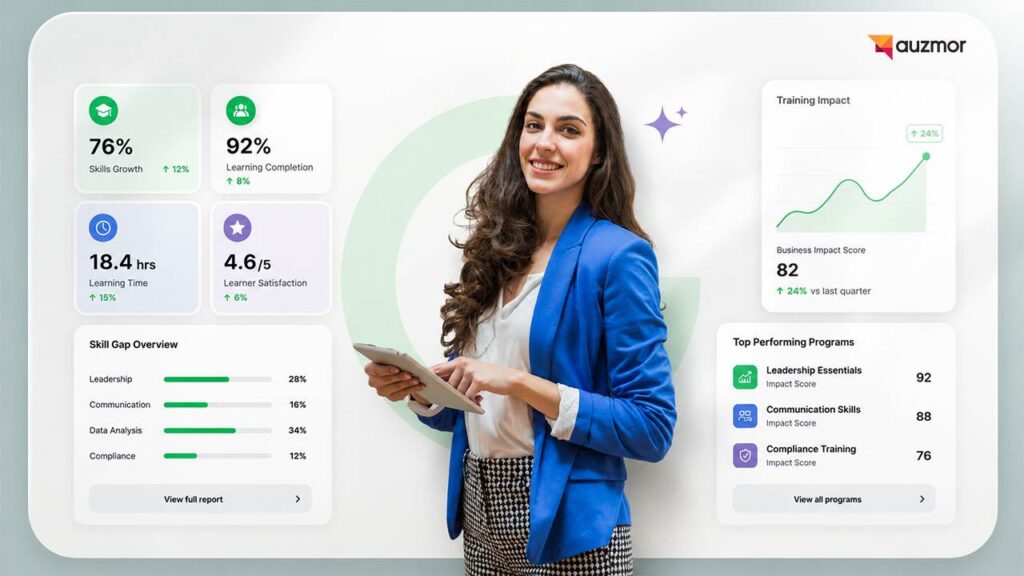
Companies that adopt a cross-trained workforce in 2025 are experiencing real benefits: Employee retention rates can increase by up to 28% when workers feel engaged and see opportunities for growth. Time-to-fill for critical positions decreases by 45% due to internal mobility and multi-skilled staff. Productivity rises across departments thanks to greater operational flexibility. Innovation scores improve by 33% as diverse skill sets promote creative problem-solving. The question is no longer what is cross trained?, but rather—can you afford not to implement it?   Are you ready to assess your organization’s readiness? Use Auzmor’s cross-training assessment tool and start creating a smarter, more resilient workforce today.

No FAQs available for this post.

Menu

Compliance training

Become audit-ready

Employee development

Compliance

Sell Training

Customer training

Partner training

training online lms

An all-in-one LMS

Content

Content Marketplace

Custom Content

Auzmor Learn

Get people hooked to learning

Auzmor Office

Unforgettable employee experience

Auzmor LXP

Tailored learning experience

Auzmor Learn

Get people hooked to learning

Content creation

Social learning

Blended learning

Reporting & insights

Mobile app

Extended enterprise

Checklists

E-commerce

Blog

Case studies

White papers

Discover top trends to facilitate smarter business practices

About

Careers

Contact

Support

join auzmor team

Join an innovative team

E-Learning Content

Content Marketplace

Custom Content

Public Sector

On-Premise

Auzmor K12

Auzmor Higher Education