



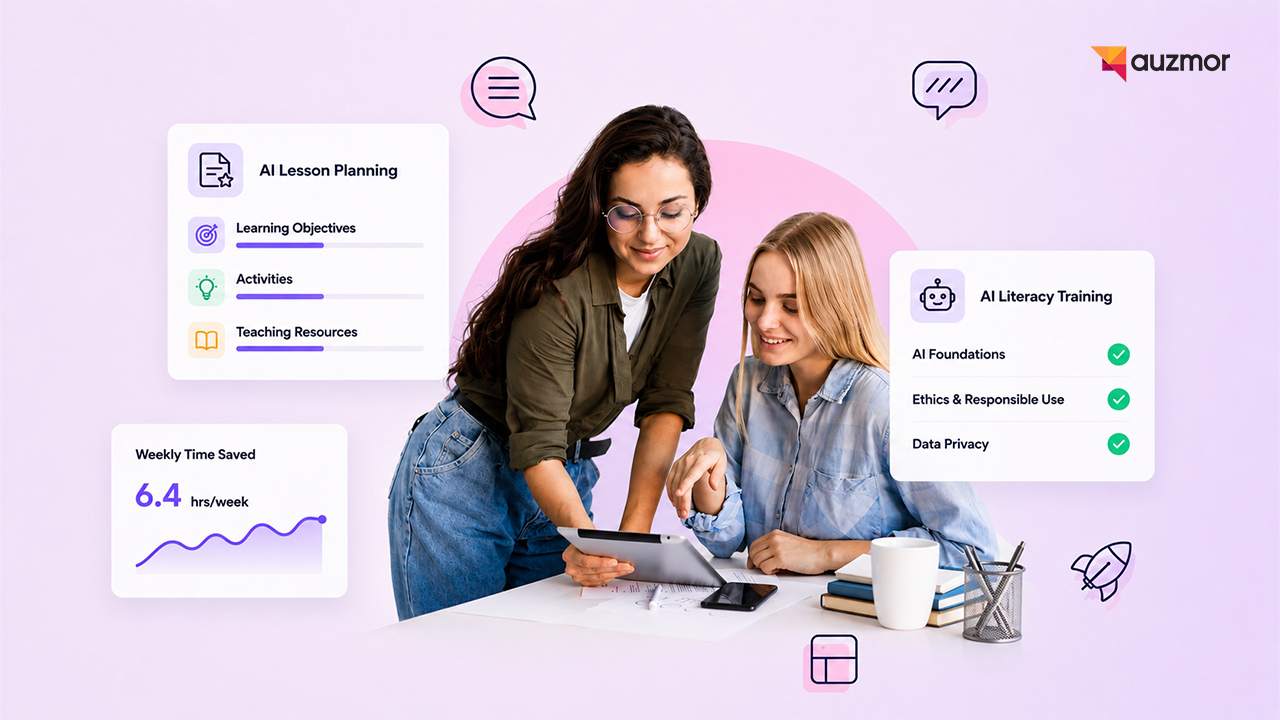
AI is no longer something schools can treat as “future planning.” It is already showing up in lesson planning, grading support, communication, research, and even the way teachers prepare for class. Across OECD education systems, around one-third of teachers report using AI in their work, and the most common uses are exactly the tasks schools care about most: summarising topics and generating lesson plans or activities. At the same time, UNESCO says rapid AI development has outpaced policy and regulatory frameworks, which is why it is pushing ethical, human-centred guidance for education systems. That combination makes the case plain: schools need AI literacy programs for educators now, not later. A practical learning partner such as Auzmor can help schools turn that urgency into a structured training plan instead of a one-off workshop.
What AI literacy means for educators
AI literacy for teachers is not about turning every educator into a programmer. It is about helping them understand what AI can do, what it cannot do, when it is useful, when it is risky, and how to judge its output with professional caution. UNESCO’s 2026 AI competency framework for teachers makes this broader point clearly: the framework spans human-centred mindset, ethics, AI foundations, AI pedagogy, and AI for professional learning. In other words, AI literacy is a teaching skill, a judgement skill, and a policy skill all at once.
That matters because educators are already using AI in ways that affect classroom practice. OECD reporting shows teachers use it to learn about topics, create lesson plans, generate student feedback, and support communication. When a tool starts influencing planning and assessment, the question is no longer whether teachers will encounter it. The real question is whether they have enough training to use it responsibly and consistently.
Why schools cannot wait
The biggest mistake schools can make is assuming AI use will stay limited until a formal policy is ready. It will not. Teachers are already experimenting, students are already using AI tools, and schools are already dealing with uneven practice. OECD’s TALIS 2024 findings show that teacher adoption varies widely across systems, which means some schools are moving fast while others are still trying to understand what is happening. That gap creates inconsistency inside the same district: one teacher uses AI for planning, another avoids it completely, and a third uses it without any shared guardrails.
There are also real risks. UNESCO has warned that the speed of AI development has outpaced policy and regulatory responses. OECD has also noted that seven out of ten teachers worry AI facilitates plagiarism and cheating. Add data privacy concerns, bias in outputs, and the possibility of over-reliance, and it becomes obvious why schools need guidance before AI becomes routine. This is exactly where a school AI policy should be paired with educator upskilling, not treated as a separate issue.
How AI literacy helps educators in day-to-day work
In the classroom, AI literacy is not abstract. It changes the quality and speed of everyday work. For lesson planning, AI can help teachers brainstorm ideas, simplify complex topics, generate examples, and adapt materials for different age groups. That does not replace pedagogical judgement. It gives teachers a faster starting point. OECD data shows lesson-plan generation is among the most common uses of AI by teachers, which suggests the opportunity is already being used in practice.
In assessment, AI can support rubric drafting, quiz creation, feedback suggestions, and review of patterns in student work. Used well, that can save time. Used poorly, it can blur standards or introduce bias. UNESCO and OECD both emphasise that AI should support, not replace, teacher judgement. That distinction matters because assessment is where professional responsibility is highest.
AI literacy also improves administrative efficiency. Educators spend a meaningful share of their time on non-teaching tasks, and schools often ask teachers to do more with less. AI can help with parent communication drafts, meeting notes, schedule summaries, or first-pass documentation. But teachers need to know how to protect student data, where human review is required, and which tools are safe to use. That is where a structured training model matters more than a “try this app” session.
For student support, AI literacy helps educators spot where AI can be useful without becoming intrusive. It can support differentiated instruction, generate practice questions, or help teachers explain a concept in multiple ways. OECD research on AI and education repeatedly frames this as augmentation: AI can amplify strong teaching practice, but it can also amplify weak practice if it is used without judgement. Teachers who understand that distinction are far better placed to support diverse learners responsibly.
What an effective AI literacy program should include
A serious program should begin with the basics: what AI is, what generative AI is, how these systems produce outputs, and why they sometimes sound confident even when they are wrong. That foundational understanding is essential because educators need to know how to question a tool, not just how to operate one. UNESCO’s teacher competency framework is useful here because it explicitly connects AI foundations with ethics and pedagogy.
The next layer should cover responsible use. That includes bias awareness, transparency, copyright concerns, academic integrity, and data privacy. Schools should also train staff on what should never be entered into an AI tool, how to handle student information, and when a human review is required before anything is shared with students or families. OECD’s guidance on AI in education stresses the importance of trained, qualified teachers who have confidence and autonomy in choosing digital tools and how they are applied.
The final layer should be practical. Teachers need classroom use cases, not just policy language. That means sample prompts, lesson-planning workflows, feedback examples, and subject-specific scenarios. It also means ongoing refreshers.
How schools can roll it out
The best rollout starts with leadership buy-in. Principals, curriculum heads, district leaders, and IT teams need to agree on the school’s stance: what AI is for, where it is allowed, where it is restricted, and how the school will support staff. Without leadership alignment, teachers get mixed messages and the program loses credibility quickly. UNESCO’s guidance for governments and policymakers is clear that immediate action and long-term policy planning should go together; schools can apply the same logic at the institutional level.
After that, train in phases. Start with a pilot group of teachers who are open to experimentation, then collect what works, what confuses people, and what needs policy clarification. Expand to subject teams next, then to the full faculty. This phased model is not just safer; it is easier to learn from. It also lets schools build examples that are relevant to their own classrooms rather than borrowing generic advice. OECD’s reports show that teacher adoption and comfort vary widely, which is another reason phased rollout is smarter than a school-wide launch with no follow-up.
Schools should also measure the program. Track participation, confidence, policy awareness, and practical adoption. Ask teachers whether AI is saving time, improving planning, or making feedback better. Ask where they still feel uncertain. Those measures matter because AI literacy is not about usage volume alone. It is about better judgement and better teaching. A learning platform like Auzmor can support that by organizing modules, tracking progress, and keeping training visible across teams, which is exactly the kind of infrastructure schools need when AI literacy becomes part of ongoing educator development rather than a one-time event.
The case for action
Schools do not need to wait for AI to settle down before they act. They need to help teachers build the confidence, ethics, and judgement to use it well now. The evidence is already strong: teachers are using AI, policy is lagging, and the most trusted global education bodies are calling for human-centred, competency-based guidance. Schools that invest in AI literacy programs for educators will be better prepared to manage risk, improve teaching practice, and make thoughtful decisions about what belongs in the classroom. Those that delay will end up reacting to tools, student behaviour, and policy problems after the fact.
The practical takeaway is simple. Treat AI literacy like any other essential professional skill. Build it into staff development, connect it to policy, revisit it regularly, and support it with a learning system that can scale. That is how schools move from uncertainty to readiness. And that is why a platform built for structured learning, like Auzmor, belongs in the conversation when schools are planning the next phase of educator upskilling.