When AI Recommendation Goes Wrong: Common Pitfalls

Bhanu Valluri
AI Recommendation Goes Wrong
AI recommendations are everywhere now. They suggest what we should watch, buy, learn, read, or do next. In business, they also shape training paths, internal mobility, product discovery, and employee experience. Used well, they can save time and make decisions easier. Used badly, they can quietly push people toward the wrong choice and create a lot of cleanup later. That risk is real enough that major guidance from NIST, the OECD, and the FTC keeps returning to the same themes: data quality, bias, transparency, accountability, and human review. For teams using Auzmor’s LMS for employee development and training, that balance matters even more, because the recommendation engine is often influencing what people learn next and how they grow. 

What AI recommendations actually do

At a basic level, an AI recommendation system looks at data, finds patterns, and suggests the next best action. That might mean a course, a job opening, a piece of content, a product, or a workflow shortcut. In learning and development, for example, Auzmor describes AI-driven learning paths and personalized training as part of its broader employee-development offering. That is the promise: give people something more relevant than a generic one-size-fits-all list. But the system is only as good as the signals it learns from, and the quality of those signals is what determines whether the suggestion is genuinely useful or just confidently wrong. (auzmor)

Why recommendation systems go wrong

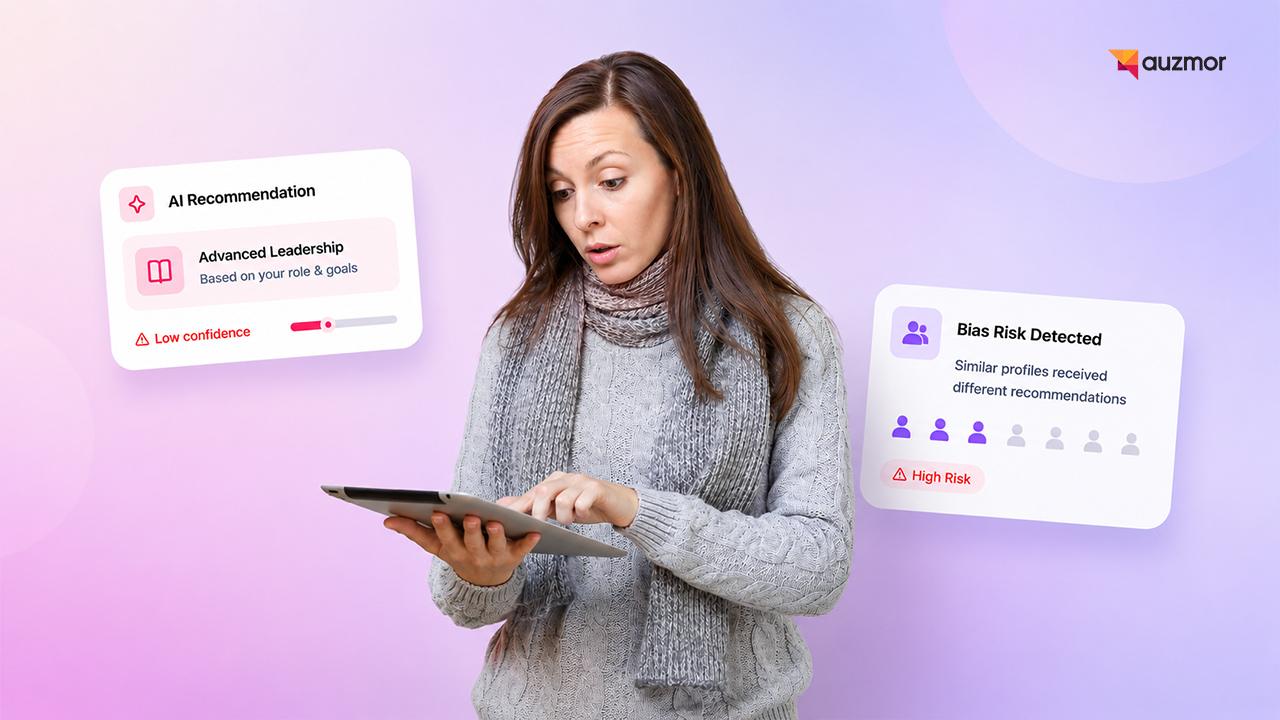
The first failure is usually the simplest one: bad data. If the model is trained on incomplete, stale, or misleading information, it will learn the wrong pattern and repeat it at scale. The FTC has described a related problem as an algorithm being aimed at the wrong target from the start, which is a useful way to think about recommendation systems too. If the goal is unclear, or if the proxy metric is weak, the system can optimize something that looks reasonable on a dashboard while missing what humans actually care about. That is why data quality and target design matter so much before anyone starts talking about model sophistication.  Bias is the next big trap. Recommendation systems can reinforce existing inequalities if the training data reflects old patterns, narrow samples, or historical discrimination. The OECD says AI can fuel bias and discrimination and can raise privacy, safety, and human-autonomy concerns; UNESCO and other policy work make the same point in education and learning contexts, where personalization can unintentionally amplify prejudice. In plain terms, if a system has mostly seen one type of user succeed in one type of role, it may keep recommending the same path to people who do not fit that mold, even when they have the potential to do well elsewhere.  A third problem is over-personalization. Personalization sounds helpful, and often it is, but it can become too narrow. Once a system gets very good at predicting what someone already likes or has already done, it may stop showing useful alternatives. Research on recommender systems continues to examine filter bubbles and the way they reduce diversity in what people see. In business settings, that can mean employees only see training that matches their current role, buyers only see one kind of solution, or managers keep getting the same “safe” suggestion rather than the better one. This is not always obvious, because the output still feels relevant. It is just relevant in a shrinking circle. 

The part people forget: trust, transparency, and oversight

A recommendation system can be technically accurate and still fail in practice if nobody understands why it is making a suggestion. NIST’s AI Risk Management Framework emphasizes documentation because it improves transparency, human review, and accountability. That matters because users are far more likely to trust a recommendation when they can see the logic behind it, or at least understand the inputs that shaped it. Auzmor makes a similar point in its recent writing on AI in learning: trust is the currency of adoption, and employees disengage when they do not trust the system recommending their training. That idea is not just philosophical; it is operational. People ignore tools they do not trust.  Weak human oversight makes the problem worse. The OECD has warned about automation bias, where people over-trust the machine and stop questioning its output. That is especially risky in HR, learning, compliance, and hiring, where a bad suggestion can affect a person’s growth or access to opportunity. A recommendation should support human decision-making, not replace it. Auzmor’s own pieces on the learning loop and internal mobility show why: when AI connects goals, feedback, training, and skills-based hiring, the best results come from a system that helps people make better decisions, not one that quietly makes them for them.  Poor testing is the final failure mode, and it is more common than teams like to admit. An AI recommendation system should not be deployed once and left alone. It needs testing before launch, monitoring after launch, and periodic audits as user behavior and business goals change. The FTC has specifically recommended testing algorithms at the outset and periodically afterward to check for disparate impact, and NIST’s guidance also stresses measurement, review, and course correction. For practical reading inside Auzmor’s own ecosystem, the company’s posts on [How to Build a Data-Driven HR Strategy with AI in 2025] and [Automated Compliance Auditing: How AI Agents Scan HR Practices for Violations] show the same underlying idea: governance is not a one-time checkbox. It is part of the system.

What the business damage looks like

When recommendations fail, the damage is not just technical. The first cost is usually trust. People stop opening suggested courses, ignore product recommendations, or treat the system as a nuisance. In learning and development, that can reduce adoption and make training programs look weaker than they really are. In commercial settings, it can lower engagement and hurt conversion. In people operations, it can create the feeling that the organization is opaque or unfair. The result is often more manual work, more exceptions, and more skepticism from users and leaders alike. A system that was supposed to reduce friction can end up creating it.  There is also a legal and reputational layer. If recommendation systems systematically disadvantage certain groups, the problem can move beyond bad UX and into compliance territory. The FTC and other agencies have warned that automated systems can perpetuate unlawful bias or discrimination, and OECD work highlights the broader risks to privacy, agency, and fairness. For a business, that means a weak recommendation model is not just an analytics issue. It can become an employment issue, a customer trust issue, or a governance issue before anyone notices.

How companies can reduce the risk

The first safeguard is to be very clear about the goal. A recommendation system should be built around a real business outcome, not a vanity metric. If you want to improve completion rates, internal mobility, or relevance, define that clearly and choose proxies carefully. Second, clean up the data. Remove stale signals, check for gaps, and ask who is missing from the dataset. Third, test for bias and for “wrong target” problems. If the output looks impressive but does not match the outcome you actually want, the model is probably solving the wrong problem. That is the point the FTC keeps returning to, and it is one of the most practical lessons in the field.  Next, build transparency into the workflow. Tell users why something was recommended, what signals mattered, and when human review is available. In many cases, a short explanation is enough. Then create a human-in-the-loop process for higher-stakes decisions. Human judgment is not a fallback because the machine failed; it is part of the design because the real world is messy. Finally, monitor outcomes continuously. Recommendations should be reviewed after launch, not just before it. The better organizations treat AI systems like living products: they evolve, they drift, and they need ongoing calibration.  Auzmor’s recent content points in the same direction. Its work on AI, transparency, and bias, along with its writing on employee goals, feedback, internal mobility, and data-driven HR strategy, all suggest a simple principle: AI works best when it supports a broader people strategy instead of replacing it. That is a sensible model for any company trying to use recommendations without letting them run the show.

Human judgment still matters

The strongest recommendation systems are not the ones that replace people. They are the ones that make people better at their jobs. That requires judgment, context, and restraint. It also requires the courage to override the model when the model is wrong. The organizations that get this right do not treat AI as an oracle. They treat it as a decision-support layer, with clear goals, clean data, transparency, and human accountability around the edges. That is where trust comes from, and trust is what makes recommendations actually useful. For Auzmor and for any business using AI in learning or talent workflows, that is the line worth protecting.

Menu

Compliance training

Become audit-ready

Employee development

Compliance

Sell Training

Customer training

Partner training

training online lms

An all-in-one LMS

Content

Content Marketplace

Custom Content

Auzmor Learn

Get people hooked to learning

Auzmor Office

Unforgettable employee experience

Auzmor LXP

Tailored learning experience

Auzmor Learn

Get people hooked to learning

Content creation

Social learning

Blended learning

Reporting & insights

Mobile app

Extended enterprise

Checklists

E-commerce

Blog

Case studies

White papers

Discover top trends to facilitate smarter business practices

About

Careers

Contact

Support

join auzmor team

Join an innovative team

E-Learning Content

Content Marketplace

Custom Content

Public Sector

On-Premise

Auzmor K12

Auzmor Higher Education