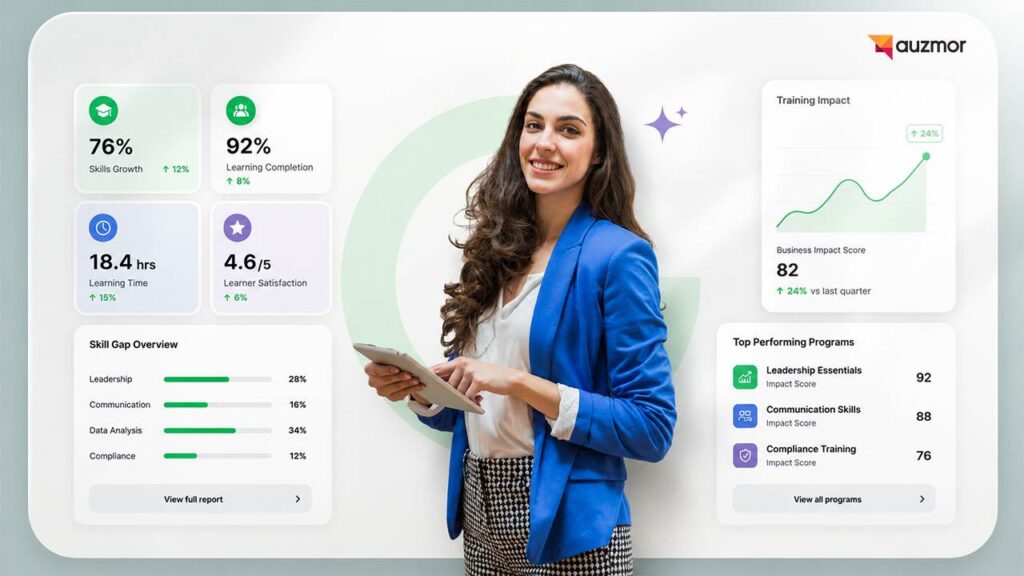



Enterprise AI encompasses the application of artificial intelligence technologies, such as machine learning, natural language processing, and predictive analytics, to all parts of an organization to speed up interactions and customize experiences. Almost all organizations are piloting AI programs, but only 1% think they have achieved enterprise AI maturity; even the L&D (learning and development) programs that already include AI models can be considered nascent. Traditional Learning Management Systems (LMS) typically employ static catalogs of courses with freemium/credit options, manual enrollment workflows, and managed course registrations for simplicity. By comparison, AI-enabled platforms utilize real-time data to make first (or automatic) content recommendations, automate administrative actions, and identify proficiency gaps before learning gaps develop.
Setting the Stage:
- Data Strategy:
A successful enterprise AI initiative starts with an AI-ready data strategy—one that makes data trustworthy, accessible, and well-governed. As Deloitte's Q3 2024 "State of Generative AI in the Enterprise" report states, 75% of organizations have already invested in data-lifecycle management increases to support AI deployments, attesting to how great AI relies on great data. Furthermore, marketing leaders are encouraged to ask four simple questions—data origin to governance controls—to verify customer data conforms to standards for generative AI use cases, referencing the importance of metadata strategies, data dictionaries, and regular quality checks.
- Skills Gap Analysis:
Even with perfect data in hand, AI initiatives fail in the absence of proper talent. Only 1% of organizations think they are AI-mature, and 68% of CEOs cannot retain and attract enough AI talent, reflecting a wide skills gap, as per the 2024 McKinsey AI Readiness Report. In the next five years, 44% of employees' skills will become obsolete due to AI, as projected by the World Economic Forum, so reskilling in a continuous manner becomes essential to stay competitive. Therefore, L&D teams must employ targeted competence tests, partner with universities or certification courses, and leverage AI-driven upskilling platforms in order to fill this gap ahead of time.
- Organizational Readiness:
AI adoption is a change-management imperative rather than a technical issue; it requires cross-functional leadership. Shobhit Varshney of IBM Consulting writes that "Cultivating AI champions among senior executives and supporting them with appropriate tools, ethical training, and a conducive culture is critical" to achieving strategic, scalable AI value. Similarly, advice to CFOs stresses, "AI can't be successful if it's owned by one department. It needs marketing, sales, IT, finance—and leadership—to pull in the same direction." To that end, organizations must create a standalone AI governance committee, define clear roles for an AI Center of Excellence or Chief AI Officer, and provide a compelling "why" at every level to overcome resistance and get stakeholders aligned around shared goals.
Key Milestones in AI Adoption:
True value of Enterprise AI is only realized when businesses go beyond individual early pilots and infuse AI into their core business. This journey calls for intentional milestones that span people, processes, and technology. Here, we discuss each major phase in detail.
1. Establishing Pilot Aims & Management
- Align with Strategic Objectives:
All AI pilots start with a clearly articulated business problem—whether it's reducing customer service churn, accelerating compliance processes, or tailoring employee learning experiences. As Agility at Scale describes it, the key to the success of these pilots is that they are able to "ground the AI initiative in real business value" and align directly with organizational KPIs, such as revenue growth or cost savings.
- Define Governance:
Governance is the facilitator between single innovation labs and company operations. An AI light-touch governance committee must set up data-usage rules, risk management, budget checkpoints, and decision-authorities upfront. Based on BCG research, 74% of companies fail to scale AI due to overlooking governance and dealing with every pilot as a unique instance instead of formalizing learnings into repeatable models.
2. Effective Pilot Design & Implementation
- Select the Appropriate Use Cases
Select pilots with high impact and logical scope. The Utility Analytics Institute recommends beginning with initiatives that involve easily accessible, high-quality data and high cross-functional sponsorship, with early success that builds confidence and encourages wider adoption.
- Iterate Quickly with Agile Techniques:
Instead of spending time trying to be perfect, you should be employing Agile sprints to produce minimum viable models, get user feedback, and iterate. In Metis Strategy's GenAI guide, a two-week pilot phase is dedicated to stability, accuracy tracking, and follow-up with users immediately—allowing for quick changes prior to enterprise rollout.
3. Establishing Success Criteria and Metrics:
- Define Quantitative & Qualitative KPIs:
Not only technical performance measures such as model accuracy and processing time, but also map pilot outcomes to business performance such as time-to-competency, learner engagement rates, and ROI. The Training Industry suggests measuring completion rates, performance gain, and cost savings to get a complete picture of success.
- Indicators for Scalability Planning:
Include metrics that predict scale problems—such as the simplicity of system integration, the efficiency of data pipelines, and the ability of the model to serve multiple user groups. These "scalability KPIs" alert teams to future bottlenecks before large-scale rollout.
4. Creating Organizational Momentum:
- Create an AI Center of Excellence (CoE):
A CoE brings together expertise, documents best practice, and offers governance control. Utility Analytics Institute states that CoEs enable "prioritization of new AI use cases," prescribe required people/process/technology, and offer roadmaps for scale.
- Evangelize Early Wins:
Develop a short "pilot pitch deck" with vital metrics and customer feedback. Small wins—such as a 20% decrease in onboarding time—are exhilarating for executives and staff alike, thereby avoiding "pilot paralysis," the condition in which teams stall after early success.
5. Developing Infrastructure and Integrating Systems:
- Invest in common platforms:
To prevent duplicated effort and technical debt, create a shared AI development platform—with shared data services, MLOps pipelines, and APIs. Hypermode research cautions that 88% of AI pilots do not scale because of siloed infrastructure and a lack of observability.
- Integrate into Core Systems
Embed AI models into current processes and business applications (e.g., HRIS, CRM). IBM's report emphasizes that scaling is more than point solutions—"AI at scale is a business," not a cool pilot—and needs to be embedded into end-to-end processes.
6. Ongoing Monitoring and Governance
- Implement Rigorous Monitoring
Leverage dashboards to monitor model performance (accuracy drift, latency) in real-time and business KPIs. Leverage alerting for anomalies to enable timely remediation.
- Governance for Responsible AI:
Sustain bias-testing procedures, explainability attributes, and human-in-the-loop review procedures. BCG's 2024 evidence indicates that better-governed organizations capture and amplify value more frequently, converting "proofs of concept" into "proofs of performance.".
7. Overcoming Common Pitfalls:
- Pilot Paralysis: Lacking a definition of "success at scale," pilots stall.
- Lack of Executive Accountability: No one owner equals no lasting momentum.
- Data & Infrastructure Shortfalls: Insufficient pipelines and platform thinking traps models in silos.
- Change-Management Failures: Users resort to legacy tools when adoption is not managed.
Tackle all these head-on with written success agreements, cross-functional "scale teams," and continuing literacy efforts that keep stakeholders and users on the same page.
Bringing AI to Your Learning Environment:
Adding AI to your learning infrastructure takes more than a switch flip. It beautifully weaves smart services into all aspects of the learning process. Next, we explore three core competencies that enable smooth and successful AI integrations.
- AI-Powered Personalization: Personalized Learning Pathways:
AI-driven personalization goes beyond the constraints of "one-size-fits-all" learning, since it adapts content continuously to match every learner's performance, preferences, and context.
- Learner Modeling and Predictive Analytics:
AI systems are trained on quizzes, interactions, and completion history to build dynamic learner profiles. Predictive models then forecast skill gaps and recommend the next best activity—whether a micro-lesson, an interactive simulation, or a peer discussion forum.
- Algorithmic Methods:
Techniques such as collaborative filtering—recommendations for content discovered useful by "learners like you"—clustering, or classifying learners with similar needs, and reinforcement learning, where recommendation strategies are optimized through testing, form the foundation of adaptive routes.
- Real-World Impact:
Hyperspace's corporate learning solution saw a whopping 40% increase in engagement, and a 30% increase in knowledge retention, by dynamically adapting content in real-time via emotion and gesture recognition.
Businesses that apply predictive analytics to suggest courses have witnessed course completion rates increase by up to 42%, along with a whopping 35% boost in student retention.
- Intelligent Content Creation & Curating:
Artificial intelligence can greatly accelerate both the creation of new learning material and the curation of existing material, for relevance and quality at scale:
- Automated content generation:
• Natural language generation (NLG) technology has the ability to generate multiple-choice questions, scenario exercises, and customized feedback in minutes.
• Large language models condense extensive reports or video transcripts into takeaways, bullet points or flashcards and thus take subject matter experts away from spending hundreds of hours on tedious manual effort.
- Smart Content Tagging and Metadata:
AI apps scan unstructured text, images, and video to pull out keywords, topics, and sentiment—tagging content automatically for instant findability. Companies attain 94% accuracy with metadata tagging, significantly minimizing time-consuming cataloging.
- Dynamic Curation & Just-In-Time Recommendations:
When a worker is confronted with an issue—like a code defect—AI-powered platforms can instantly deliver relevant tutorials, knowledge-base entries, or micro-courses written by other workers. This "just-in-time" learning has already been shown to decrease learning friction by up to 50%, while at the same time improving job performance.
- How Auzmor LMS Enables AI-Powered Learning:
With its AI-driven recommendation engine, Auzmor LMS enables companies to tailor their courses of study—thereby boosting completion rates by as much as 30%—together with effortless integration with current HRIS and collaboration tools.
Seamless integration and interoperability:
To unlock AI's full power, intelligent services must feed and be fed by your broader tech stack:
- Open APIs and Standard Protocols:
Use Learning Tools Interoperability (LTI) and RESTful APIs to integrate AI engines into HRIS, CRM, collaboration suites (e.g., Teams, Slack), and single-sign-on systems—abolishing data silos and manual syncs.
- Modular, Cloud-Native Architecture:
Microservices architecture lets you scale discrete functions—such as recommendation services, analytics dashboards, or content-processing pipelines—without needing to rearchitect the entire LMS.
- Data Security & Flow:
Ensure learner data is securely transferred between systems. Encrypt at rest and in transit, along with role-based access controls and auditing, to enable GDPR, CCPA, and enterprise security policy compliance.
As organizations chart their journey from AI experimentation to company-wide adoption, three foundation pillars of people, data, and governance remain crucial. Clean, well-governed data enables machine learning models to deliver reliable insights; a well-trained workforce ensures the insights are properly executed; and strong executive sponsorship backed by solid policy sets AI projects into business DNA. When these elements are aligned, pilots get transformed into scalable solutions that deliver quantifiable outcomes, from reduced time-to-competency to higher employee engagement and measurable ROI. Embedding AI in your learning environment transforms static course catalogs into interactive, dynamic spaces.
Fueled by AI-based personalization, smart content curation, and open, API-first architecture, Learning and Development executives can provide timely, just-in-time learning experiences that actually matter to every learner and advance business outcomes.
With ongoing monitoring, ethical guardrails, and a fully dedicated Center of Excellence, we guarantee that models not only work well but do so responsibly, maintaining learner trust and regulatory compliance in check as your programs grow. In the coming years, the speed of innovation—from generative AI to immersive VR/AR—will continue to transform the way we work and learn.
L&D teams will need to be nimble, adopting new technologies and creating an experimental culture. Start by performing an AI-readiness assessment, starting a pilot with specific success metrics, and establishing an AI governance committee. As you ramp up, think about hiring an AI-ready LMS provider like Auzmor, whose easy-to-use platform speeds AI-based learning without affecting your current processes.