



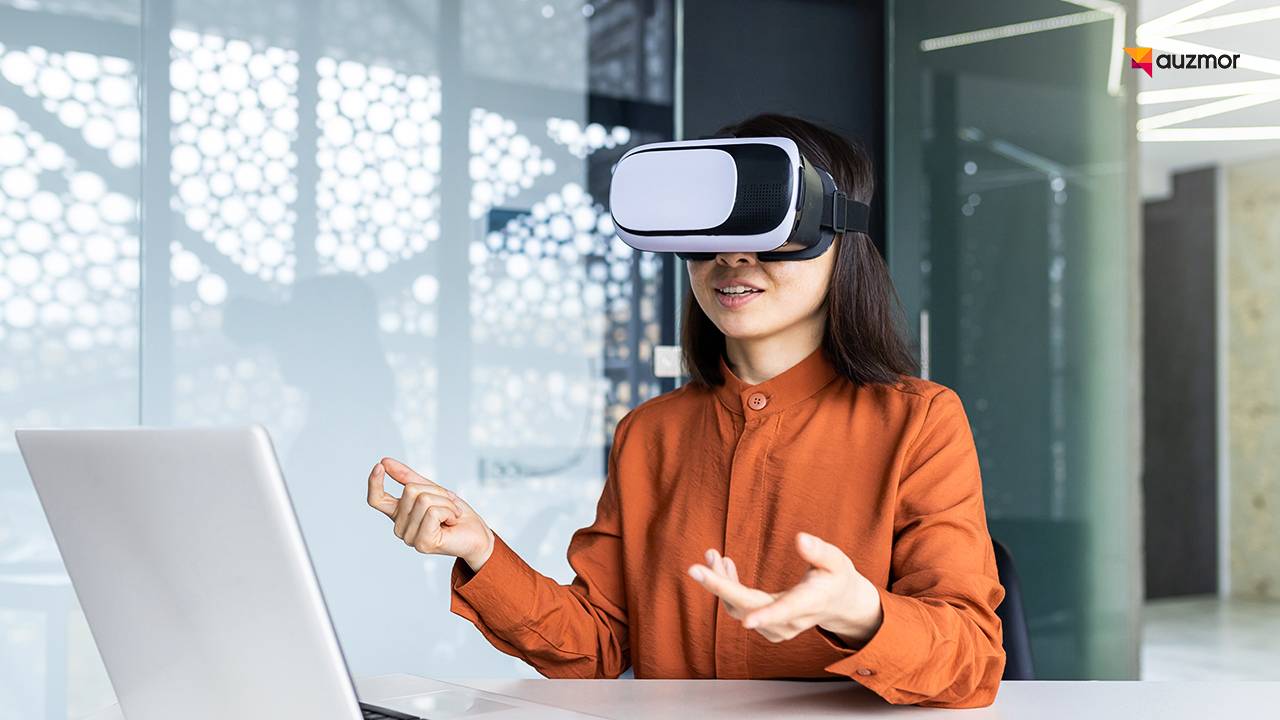
Corporate training budgets are shrinking while expectations for rapid upskilling are hitting all-time highs. Business leaders simply cannot afford to pull operational teams off the floor for week-long seminars anymore. Emerging programs that combine artificial intelligence with augmented and virtual reality solve this exact problem. They cut training time drastically and build genuine confidence for learners at scale.
Immersive learning places employees inside interactive, digitally constructed environments so they can practice real-world skills safely. Adding AI to these spatial environments transforms them from static 3D videos into responsive training grounds. The results speak volumes for business outcomes. For example, researchers in a major PwC enterprise study on VR and soft skills found that VR learners completed their training up to four times faster than classroom peers. Those same learners reported a massive spike in their confidence to act on the material afterward.
This article outlines how business leaders can combine AI and AR/VR to generate measurable ROI. We will look at what success actually looks like in pilot programs and explore how to connect these experiences into a corporate LMS for proper tracking.
Why immersive learning matters for enterprise and consumer businesses
Executives want one thing from their training programs: faster time to competency. Immersive learning delivers this by forcing active physical participation. Employees stop passively clicking through slides. Instead, they practice critical tasks inside highly realistic digital replicas of their exact workspaces. This spatial methodology builds muscle memory and mental readiness far better than traditional video modules.
Safety presents a massive advantage for enterprise organizations. Industrial technicians need to practice repairing heavy machinery. Doing this in the real world risks physical injury and requires taking vital revenue-generating equipment offline. Virtual reality creates a perfectly safe sandbox. Retail staff can face intense customer crowds or Black Friday scenarios before they ever step onto a physical store floor. Simulated repetition removes the fear of failure.
Spatial computing platforms also give managers an unprecedented level of data. Traditional training only tells you if someone passed a multiple-choice test. Immersive training tracks eye movement, hand speed, and decision-making under pressure. Industry researchers evaluating the holistic ROI of immersive learning technologies point out that these metrics translate directly to the bottom line by eliminating material waste and centralizing training without travel costs.
Consumer-facing brands see similar gains. Customer service representatives use AR to master complex physical products from their home offices. A 3D simulation of a new appliance allows remote agents to practice troubleshooting steps instantly. Passive reading creates a compliance paper trail. Active problem solving in a 3D space actually builds operational capability.
How AI supercharges AR/VR experiences
Augmented and virtual reality provide the digital stage. Artificial intelligence provides the brain. Early corporate VR modules relied on rigid scripts. Every trainee experienced the exact same sequence of events, which meant advanced employees grew bored and novices easily became overwhelmed. Injecting AI into these environments completely changes the dynamic by creating highly adaptive learning pathways.
Machine learning algorithms constantly analyze user inputs in the background. Imagine an employee hesitating during a simulated hazardous material spill. The AI detects the delay and dynamically adjusts the scenario, perhaps offering a targeted hint or slowing down the environmental hazards. This intelligent scenario branching gives beginners the scaffolding they need while throwing complex curveballs at seasoned veterans. Recent academic work detailing AI-powered frameworks for adaptive, personalized learning confirms that tailoring content delivery to individual cognitive paces drastically improves retention.
Generative AI and Retrieval-Augmented Generation (RAG) solve the biggest historical problem with VR: content updates. Previously, changing a compliance rule meant hiring expensive developers to rebuild a 3D environment. Now, developers just update the underlying RAG knowledge base. The AI avatars and virtual instructors pull from this updated database instantly. They can answer spontaneous user questions based on the newest company policies without requiring a single line of new code.
Industry leaders are paying attention to this shift. As one training expert noted recently (paraphrased), VR lets learners practice rare, high-stakes moments at scale; AI makes each practice session smarter by adapting to the individual user.
This creates a flawless feedback loop. Automated assessment tools grade verbal responses and physical actions simultaneously. The system evaluates the performance and pushes the data to administrators in real time. Moving from onboarding to upskilling becomes a seamless journey. AI ensures every module challenges the learner appropriately.
Business use cases and quick ROI math
Enterprises currently deploy AI-enhanced VR across several high-value corporate domains. Employee onboarding is a prime example. Remote hires can explore a virtual headquarters, interact with AI-driven colleagues, and absorb company culture weeks before their official start date. Compliance training also gets a major upgrade. Teams hunt for workplace hazards in a simulated 3D warehouse instead of watching a dated corporate safety video.
Technical skills training sees massive benefits from this technology. Assembly line workers practice intricate protocols without wasting expensive raw materials or breaking sensitive tools. On the soft skills side, customer service agents practice de-escalation techniques with AI avatars. These avatars are programmed to simulate varying levels of frustration, giving employees a safe space to practice empathy and conflict resolution.
Leaders absolutely must calculate a clear financial return to justify buying headsets and software licenses. A recent VR training ROI brief demonstrates that enterprise deployments reach breakeven points surprisingly fast. The savings come directly from reduced operational downtime and eliminated travel expenses. The earlier PwC benchmark noted that VR training becomes cheaper than classroom learning once you hit roughly 1,950 learners. At the 3,000 learner mark, VR actually costs 52% less than classroom equivalents.
Let us look at a short illustrative ROI micro-calculation for a mid-sized logistics firm rolling out a new protocol to 500 warehouse managers.
- Traditional method: The physical course takes 4 hours. The fully loaded employee cost is $40 per hour. The time cost per employee equals $160. The total training time cost is $80,000 (500 learners × $160).
- Immersive method: VR reduces the required training time by 75%. The course now takes just 1 hour. The new time cost per employee drops to $40. The total time cost is now $20,000 (500 learners × $40).
- The savings: The firm saves 3 hours of payroll per employee. The gross financial savings on employee time alone equals $60,000.
Even if we assume a $30,000 initial investment for hardware and software licensing, the firm gets a net positive return of $30,000 during the very first training cycle. This calculation completely ignores the added financial value of having fewer workplace accidents or a lower employee turnover rate.
Implementation checklist for leaders
Buying headsets is the easy part. Deploying immersive technology successfully requires a highly structured plan. Leaders need a specific roadmap to prevent their pilot programs from stalling out.
- Define clear objectives: Figure out the exact behaviors you want to change before looking at technology. Never adopt VR just because it looks modern. Tie the initiative to a specific business metric like error reduction or faster onboarding times.
- Choose the right content partner: Find vendors who understand both spatial design and enterprise AI architecture. A beautiful 3D environment is useless if the backend tracking is broken.
- Design a pilot program: Start small to limit your financial risk. Roll the technology out to a single department first. High-stakes emergency response training or complex equipment repair are excellent starting points.
- Formulate a device strategy: You must decide between standalone headsets, PC-tethered units, or lighter mobile AR solutions. Plan for the physical realities of the hardware. Figure out how you will sanitize the devices and store them securely between shifts.
- Establish a measurement plan: Decide how you will capture and analyze user data before a single employee puts on a headset.
- Integrate with your LMS: Standalone VR applications create terrible data silos. Connect your headsets to a platform that actually supports blended learning. You need robust learning analytics to monitor immersive completion rates directly alongside traditional coursework.
- Scale deliberately: Use the concrete financial data gathered from your pilot program to secure executive buy-in for a global rollout.
Connecting these tools to your existing infrastructure prevents massive administrative headaches. A modern corporate learning platform centralizes all training records and keeps your HR data perfectly clean.
Risks, ethics, and pragmatic limits
Leaders have to look at the pragmatic limits of XR and AI integrations honestly. Hardware costs are dropping, but they still represent a major barrier for smaller companies. The physical logistics of managing a fleet of headsets require dedicated IT support. You have to handle battery degradation, software patches, and broken straps daily.
Privacy and data security also pose serious ethical questions. Spatial computing devices capture incredibly intimate biometric data. This includes pupil dilation, eye-tracking patterns, and unique physical movement profiles. Furthermore, generative AI models can easily introduce hidden bias into simulated workplace scenarios if developers do not test them rigorously.
Academic reviews covering systematic reviews on AI + VR effects and ethical limits emphasize that companies need strict data governance policies. You have to protect employee biometric data just like you protect their social security numbers. Accessibility remains another hurdle. Immersive headsets can cause motion sickness for certain users and might exclude employees with specific physical or visual disabilities. Organizations must always provide alternative training methods.
Conclusion
Combining artificial intelligence with AR and VR creates a deeply effective training environment. Business leaders can drastically reduce the time it takes to build competency while giving their employees a safe place to fail and learn. However, lasting success relies on moving past the pilot phase and connecting your spatial learning data to broader organizational goals. You cannot manage what you cannot measure. Explore how platforms like Auzmor can help you pilot AI-powered immersive modules and measure impact smoothly. Check out Auzmor Learn to discover how a modern corporate platform connects your entire learning ecosystem.