How to Build a Training Roadmap for New Hires Using an LMS

Bhanu Valluri
How to Build a Training Roadmap for New Hires Using an LMS (1)
Let us talk honestly about those first few weeks on the job. It is a make or break period for any fresh employee. According to Gallup, only 12 percent of employees strongly agree their organization does a great job of onboarding new talent. That is a staggering failure rate. It means 88 percent of workers walk into a new role and almost immediately feel confused, unsupported, or completely overwhelmed by their new environment. First impressions absolutely dictate long term performance. In fact, research from the Society for Human Resource Management shows that employees who experience a structured onboarding program are 69 percent more likely to remain with a company for at least three years. When people start a new job today, they usually face a highly chaotic environment. They get bombarded with scattered PDF documents. They receive endless emails with broken links to old portals. They sit through confusing scheduling mix ups. A proper training roadmap for new hires fixes this massive operational mess. It provides a highly structured, predictable timeline that guides individuals from their very first introduction all the way to full productivity. By utilizing a Learning Management System, companies can finally transform a disjointed orientation process into a smooth and trackable journey.

Why a Training Roadmap for New Hires Matters

Relying on a quick office tour and a thick binder is a relic of the past. Modern teams move too fast for the old sink-or-swim method. A documented roadmap gives new hires a clear path, reduces confusion, and helps managers deliver training without repeating the same instructions over and over again. A roadmap also supports psychological safety. When people know what to do today, what to expect tomorrow, and how the next few weeks will unfold, they spend less energy guessing and more energy learning. That structure is especially valuable for remote and hybrid employees who cannot simply tap a coworker on the shoulder for help. It also lightens the load on managers. Instead of manually explaining the same policies, tools, and workflows to every new hire, leaders can rely on the LMS to handle the repetitive basics. That frees them to focus on mentoring, coaching, and relationship-building.

What Your LMS-Powered Roadmap Should Include

Not all training programs are created equal. A solid roadmap should cover compliance, culture, product knowledge, and internal processes. The goal is to build a foundation that is useful without overwhelming people on day one. Start with compliance and security training. That includes data privacy, cybersecurity, workplace safety, and any role-specific legal requirements. These modules are rarely thrilling, but they are essential. The trick is to place them early without making them the whole story. Next, include company culture content. New hires should understand the mission, values, and the bigger purpose behind the business. They should also understand how their role fits into the larger picture. Then move into product and service training. Keep it gradual. Dumping an encyclopedia of product details onto someone in week one will only create overload. Break the material into smaller modules and give learners room to absorb it. Finally, include soft skills and internal workflows, such as communication norms, collaboration tools, and escalation processes. For advice on making learning more effective and flexible, the post on 5 Innovative Ways Companies Are Using Online Learning Platforms offers a helpful lens on microlearning and digital delivery.

A Step-by-Step Framework for Building Your Timeline

A timeline works best when it is broken into phases. Trying to teach everything in a single week is a recipe for glazed eyes and half-remembered instructions. Spread the learning out over 30, 60, and 90 days so people can absorb, practice, and revisit the material. Before day one, use the LMS to send a welcome video, share the first-week schedule, and complete basic administrative tasks. That way, the first official day can focus on connection rather than forms and logins. During the first week, focus on orientation and team integration. Assign short modules that explain the business model, key contacts, and foundational processes. Keep the pace light and pair digital learning with live conversations. At the 30-day mark, shift toward daily workflows and role-specific tools. By day 60, add deeper product learning, shadowing, and hands-on practice. By day 90, move into advanced tasks, cross-functional collaboration, and a formal review of the original roadmap.

Personalizing the Roadmap by Role and Department

A one-size-fits-all approach rarely works for growing organizations. A marketing manager, a backend developer, and a sales executive all need different knowledge, different tools, and different milestones. Your LMS should be able to assign tracks based on job title, department, or location. This is where personalized onboarding becomes especially valuable. A new sales representative might get modules on objection handling and CRM workflows, while an HR coordinator receives training on employee policies and benefits management. That kind of relevance makes the experience feel thoughtful instead of generic. For a deeper look at that idea, Auzmor's The Role of Personalized Onboarding in Shaping a Positive Employee Experience connects neatly with this section. If you are building content from job roles, How to Create Training Modules from Job Descriptions is another useful internal link.

Measuring Success with Reporting and Manager Feedback

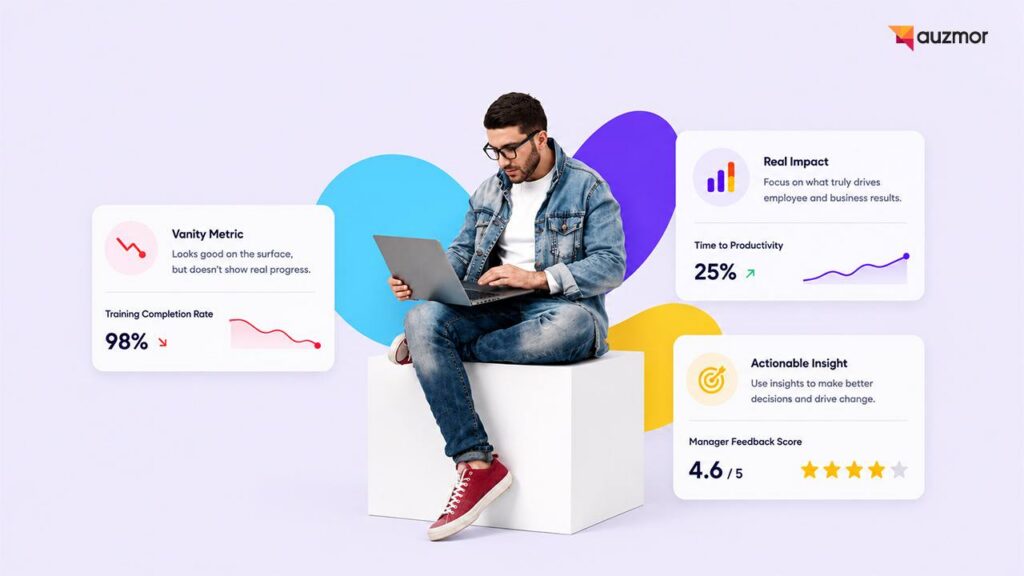
You cannot improve a process you refuse to measure. Training design is only half the job. The other half is tracking engagement, completion, assessment results, and retention signals so you can see what is working and what is not. LMS reporting makes this easier. If a specific quiz or module is causing repeated failure, that is a sign the content may need to be clarified, shortened, or redesigned. Completion rates, time spent, and assessment scores all help reveal bottlenecks. But numbers do not tell the whole story. Managers should also gather qualitative feedback through weekly check-ins and quick surveys. Ask new hires whether the pacing feels right, where they feel stuck, and what still seems unclear. For a stronger data lens, link to How to Track Employee Training Using LMS Reports.

Common Mistakes to Avoid

The most common mistake is information overload. Dumping too much content into week one creates burnout and poor retention. A better approach is to sequence training across the full 90-day journey. Another mistake is forgetting the human element. An LMS is a powerful delivery tool, but it should never replace live guidance, mentorship, or buddy support. Technology should make onboarding smoother, not colder. It is also easy to overlook remote workers. If your roadmap depends on hallway conversations and in-office osmosis, remote hires will miss critical context. Make the invisible visible by documenting it in the LMS. Finally, do not treat the roadmap as a one-and-done document. Review it regularly, update it when products or processes change, and keep it aligned with the way your business actually works.

Securing Long-Term Success with the Right Tools

Building a training roadmap takes time, but the payoff is worth it. Better onboarding can improve confidence, strengthen retention, and shorten the path to productivity. The right LMS helps you automate the heavy lifting, keep content organized, and deliver learning paths consistently. Auzmor's From Onboarding to Upskilling: How LXP and LMS Support Employee Development is a strong companion piece for teams thinking beyond onboarding and into long-term growth. Start by mapping the first 90 days on paper, identify the most important milestones, and then turn that plan into automated learning paths. With the right structure in place, new hires get clarity, managers get time back, and the organization gets a stronger start every time.

Related Posts

Menu

Compliance training

Become audit-ready

Employee development

Compliance

Sell Training

Customer training

Partner training

training online lms

An all-in-one LMS

Content

Content Marketplace

Custom Content

Auzmor Learn

Get people hooked to learning

Auzmor Office

Unforgettable employee experience

Auzmor LXP

Tailored learning experience

Auzmor Learn

Get people hooked to learning

Content creation

Social learning

Blended learning

Reporting & insights

Mobile app

Extended enterprise

Checklists

E-commerce

Blog

Case studies

White papers

Discover top trends to facilitate smarter business practices

About

Careers

Contact

Support

join auzmor team

Join an innovative team

E-Learning Content

Content Marketplace

Custom Content

Public Sector

On-Premise

Auzmor K12

Auzmor Higher Education