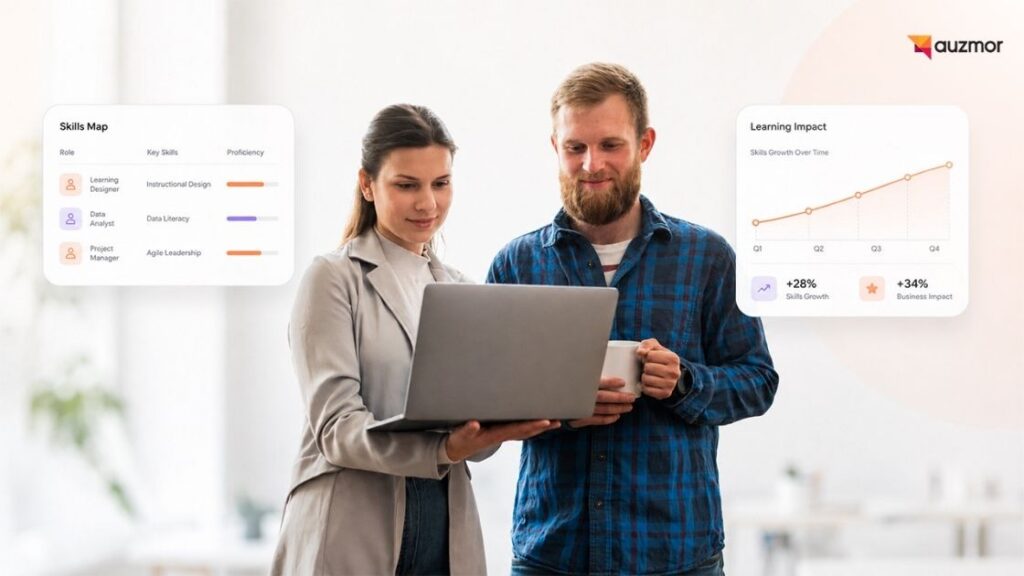



In 2025, Learning and development has been the most discussed topic and yet the most visible measure for learning, the course completion, doesn't tell us much about the bottom line impact. According to Deloitte, 12% of CEOs believe that completion rates actually predict employee performance outcomes. This underscores a major disconnect between what's exactly easy to measure and what matters to business success. Now, CEOs, CHROs and L&D leaders need sharper metrics that connect learning investments to measurable operational results. This is where AI plays a crucial role and we are going to explore that in this blog.
The question to the leaders is, Will you keep chasing "vanity metrics" or will you deploy the analytics that actually move the needle?
Let's dig in.
The Limits of Completion Rates:
Completion rates are a relic of archaic training system. It's a proxy that is easy to collect but rarely indicative of real change. Always remember that "finishing a course is not a proof of skill mastery, retention or any meaningful behaviour change". Those archaic rates may indicate exposure but not engagement or application in a business context. In fact, Industry studies and education researches consistently argue that completion rates are at best a participation indicator not performance one.
Kirkpatrick's Four Levels:
Kirkpatrick's Four Levels of Evaluation have served as the gold standard training evaluation since the 1950s. But critiques by ATD and other industry leaders have voiced their weaknesses. Here are some of the extracts from the research:
- Most organizations focus on Level 1 (Satisfaction) and Level 2 (Learning Outcomes), while Level 3 (Behavior) and Level 4 (Results) are rarely reached due to complexities and lack of easy metrics.
- The model usually assumes a straightforward progression from satisfaction to results. It ignores context, motivation and real life application.
- The data collection at each level can always be crude, missing the nuanced dynamic patterns.
AI Metrics That Matter In Learning Key Learning Metrics That Matter
- Engagement Score
AI-enable LMS platforms monitor numerous sophisticated learner interactions such as clicks, time spent on modules, participation in discussions, and feedback loops.
High engagement is associated with better on-the-job performance and greater retention of knowledge. A 2024 IJCISS study discovered that firms that took advantage of AI-powered engagement analytics experienced increased motivation and participation levels, ultimately driving significantly better performance results.
- Knowledge Retention & Mastery
AI uses spaced repetition and adaptive recall algorithms, regularly measuring retention and mastery over time and not just at the end.
Intermittent AI-driven testing gets people to continue using their skills in the long-term. McKinsey and industry academics report that companies implementing spaced repetition with AI have higher knowledge transfer rates and get more out of the application of skills on the job.
- Behavior Change & Performance Improvement
The most important metric is behavioral. It's to see if team members actually use what they're learning and make it work towards desired business results? The AI tools sift through performance data (actual sales conversion, customer satisfaction, productivity gains or whatever relevant KPI) and determine the relationship between those data and learning interventions. According to sources, only by measuring actual on-the-job behavior can organizations ensure that training converts to value which goes beyond just “knowing.
- Time to Proficiency (or Competency)
AI tracks learner paths to estimate when people arrive at full proficiency, the point at which they can perform to a criterion like meeting a business goal. The benefit is quicker “time to value” which has a direct positive impact on the bottom line. It also means employees start contributing their new found skills faster, saving on support costs and achieving ROI earlier. According to a 2025 LinkedIn report, AI-based onboarding can reduce time-to-competency for new hires by 25%.
- Predictive Analytics & Risk Flags
AI uncovers early warning signs. Signs such as employees who might be at risk of dropping off, gaps in capabilities in teams, or stagnating engagement. Proactive interventions, fuelled by predictive analytics, can cut remediation costs by 30%. A 2021 predictive analytics project delivered 87-96% accurate flagging of at-risk students, providing the necessary intervention and driving engagement.
- Learning ROI & Business Outcomes
AI links learning interventions directly to business KPIs such as revenue, cost savings, regulatory compliance, employee loyalty, and employee satisfaction.
Top performing companies (“best in class”) using these advanced analytics demonstrate better levels of productivity and accuracy through direct connection to both team performance and financial performance. According to McKinsey aligning talent metrics with business KPIs results in higher total shareholder returns.
Best Practices & Implementation Tips:
- Identify KPIs that correlate to financial, operational, and compliance results before choosing your metrics.
- Connecting AI-driven dashboards directly to HRIS, CRM and other line-of-business tooling to get a full-funnel view of learning impact.
- Give your front-line leaders the power to turn AI insights into coaching and development plans.
- Leverage real-time feedback and algorithm updates to make sure that your analytics reflect actual workforce impact over time.
Lets take Healthcare use case as an example:
The challenge in healthcare industry are their strict regulatory requirements and constant changes in best practices and protocols. In such cases, AI based LMS platforms can assign compliance training to equip staff with simulations, and flag "at-risk" learners which can include employees who are failing behind on required certifications while providing managers with predictive dashboards. Healthcare organizations have seen up to 40% of reduction in compliance breaches, effective onboarding and improved patient care metrics through better trained and continuously assessed staff.
How Machine Learning Drives Better Reporting in Modern LMS:
AI-driven learning management systems (LMS) offer a quantum leap in the depth and actionability of learning data, compared to legacy approaches. Let’s take a deeper look at how these sophisticated solutions (such as the likes of Auzmor’s LMS platform) collect, analyze and convert learning metrics:
- Data Integration: Connecting the Dots
Data sources AI-enhanced LMS interfaces to reach far and wide:
Educational Content: Records all touchpoints such as page views, video watch time, quiz attempts.
System Integrations: Integrates with HRIS, CRM, and other productivity systems to layer learning with business results.
Open Standards: Complies with both SCORM (for legacy course compliance) and xAPI(Experience API), which allows to track granular, event based data for learning, even outside of a traditional LMS, including mobile, simulations, games, and experiences that are blended or offline.
- Real-Time Behavioral Tracking
Through AI, advanced Learning Management Systems are able to record and analyze something more than just completions:
Clickstreams: This technology tracks every click, scroll, pause, and tap of a link, giving a detailed picture of how users engage.
Time on Task: This measures not time spent logging into the program or activity but instead active time, working constructively on training materials themselves.
Involvement Patterns: This is where AI kicks it up a notch: For example, instructing trainees when they 're skimming over content, spending more time on any part of the module than others or just avoiding altogether.
- Automated Assessments and Adaptive Pathways
AI built learning journeys, journeys that continuously adapted passes:
Adaptive Content Delivery: The system suggests new modules following evaluation of data on student performance (or maybe supplementary materials), and can detect weak spots in your comprehension.
Dynamic Quizzing: Natural Language Processing (NLP) self-generates personalized quizzes for students with special features and even indicates likely areas of ignorance to pay attention in.
Spaced Repetition Algorithms: AI will fix your recall rate and intelligence degree at max. The software will schedule reviews and touchpoints exactly when they are due for most good memory retention and skill masterly you can enjoy.
- Predictive & Prescriptive Analytics
Risk Alert: On the basis of behavior signalling (e.g., low scores or reduced activity), AI officer can be made to identify students who are likely to not engage or otherwise underperform. It then suggests that managers or systems make some kind of automation intervention.
Predictive Performance: AI models can predict which training segments are most likely to pay off in improved performance, skill acquisition or business results.
- AI-Driven Business Alignment
Correlation Engines: AI is able to check profitability, compliance ratings, sales conversions and average employee length of service by combining all the learning activity data with business KPIs,
Personalized Dashboards: Daily Tools make sense out of mountains of learning data gleaned via visual information for the people in charge; exactly which content or procedures are making results better, as well as teams that are pushing forward.
- Robust Reports & Continued Feedback
Reporting System: Higher ups in the management receive a scheduled, customisable analytics on everything which will range from course engagement and pass/fail ratios to real world outcomes those learnings can generate.
Interactive "Drill Downs": Leaders can slice and dice data by team, their roles, department and even specific quiz questions to understand where their organisational strengths and issues lie.
Conclusion:
The future of workplace learning belongs to organizations that just see beyond completion rates and prioritise real business impacts their employees are bringing to the table. The tracking participation has its place but a deeper data driven understanding of skill mastery, behaviour change and measurable performance truly changes employee development. Solutions like Auzmor LMS allows business leaders to seamlessly connect learning programs to tangible results. They turn raw data into insights and those insights turn into actions. If you are ready to move past traditional, surface level metric, it may be the right time to review your current approach.