



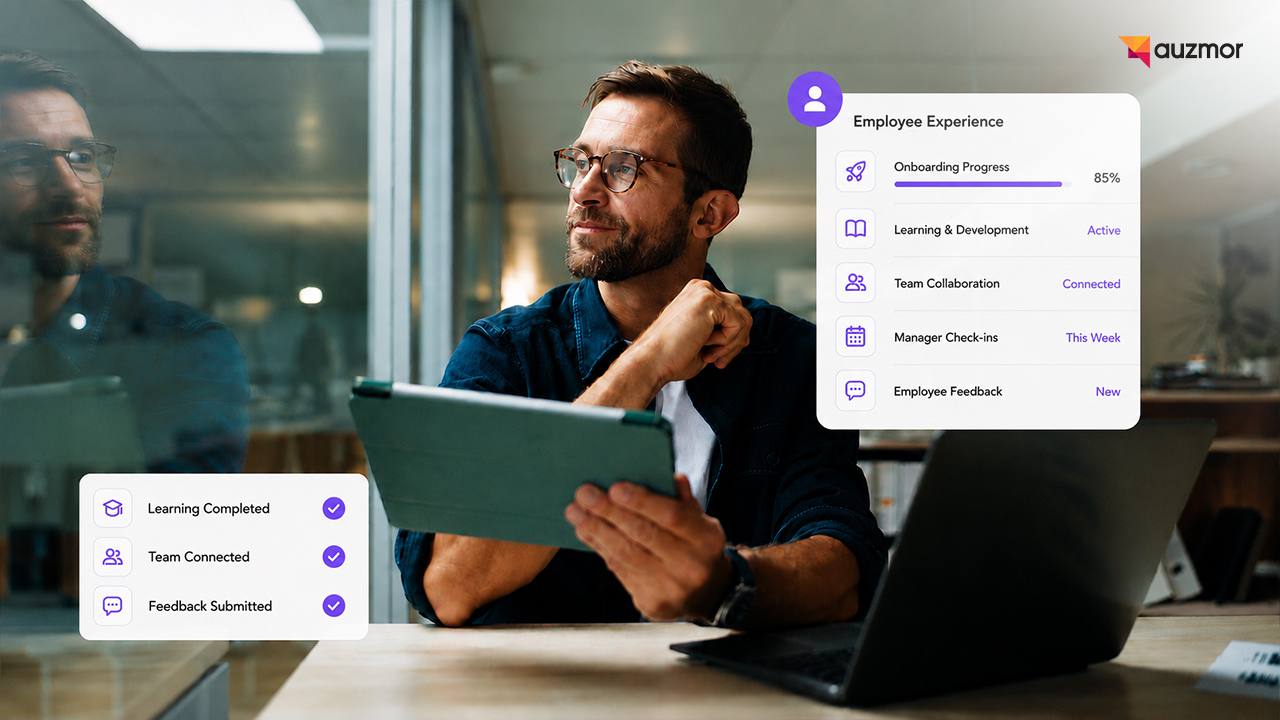
Employee experience used to sit comfortably inside HR. It was about onboarding, benefits, maybe a few pulse surveys, and the occasional culture initiative. That view does not hold up anymore. The systems people use every day now shape how they feel about work just as much as policy does. When software is clunky, communication is scattered, training is hard to find, or managers do not have the right tools, the employee experience suffers. That is why more organizations are treating EX as a technology strategy, not just an HR program. Auzmor’s own work around employee training and learning reflects that shift: the platform is built around helping teams learn, collaborate, and measure progress in ways that fit modern work.
Put simply, employee experience is the sum of everything an employee goes through at work, from the first day to the last. It includes the tools they use, the clarity of communication they receive, how easy it is to learn, whether their manager supports them, and whether the organization makes it easy to do good work. Deloitte’s 2026 human capital research says organizations are now trying to move faster, stay adaptable, and orchestrate work more intelligently, which makes EX a business design issue as much as a people issue.
What employee experience really means
A lot of companies still describe employee experience in soft terms: morale, engagement, culture, satisfaction. Those things matter, of course. But EX is more practical than that. It is the daily reality of work. Can a new hire find what they need on day one? Can a manager coach a team without digging through five systems? Can someone learn a new skill without waiting three weeks for a workshop? Can employees get answers without filing a ticket for every small thing? Those are experience questions, and they are also technology questions.
That is also why employee experience is no longer separable from culture. The argument is that culture is how people experience the organization’s values in practice. In other words, culture is not only what leaders say. It is what employees feel when they use the systems, follow the workflows, and interact with the people around them. Technology either reinforces that culture or quietly breaks it.
Why technology became central to EX
The shift happened because work itself changed. People work across locations, time zones, and devices. Learning happens in smaller bursts. Communication is both synchronous and asynchronous. Managers are expected to do more with less time. In that environment, the tools around the employee become part of the experience, not just support for it. Communication tools for remote and onsite teams shows how collaboration platforms are evolving to support hybrid work, while its LMS feature guide highlights integration, automation, mobile readiness, social learning, and analytics as core capabilities rather than nice extras.
This is where the technology strategy comes in. The right stack reduces friction. The wrong stack adds it. One system can handle onboarding. Another can deliver training. A third can collect feedback. A fourth can surface manager insights. When those systems are disconnected, employees end up repeating information, waiting for approvals, or hunting for answers. That is not just inefficient. It creates a poor experience, and poor experience compounds quickly.
A practical example is learning. A modern learning platform is not only a repository for courses. It is an experience layer. It can guide new hires, recommend relevant content, track progress, support blended learning, and help managers see where a team is struggling.
The business impact is real
The business case is stronger than many leaders realize. Gallup’s 2026 State of the Global Workplace report says global engagement fell to 20 percent in 2025 and cost the world economy an estimated $10 trillion in lost productivity. That is not an HR side note. That is a business problem at scale. Gallup also says employee engagement is tied closely to productivity, profitability, and sales.
Managers sit right in the middle of that equation. Gallup reports that 70 percent of the variance in team engagement is determined by the manager, and the same research shows manager engagement dropped from 27 percent in 2024 to 22 percent in 2025. It also found that 70 percent of managers said they had no formal training for leading hybrid teams. That should make every operations, HR, and L&D leader pause. If managers are the main lever for engagement, then manager enablement is not optional. It is infrastructure.
There is also a retention angle. When employees have to fight their way through onboarding, training, communication, and feedback, they tend to disengage faster. When those moments feel smooth, they are more likely to stay, contribute, and grow. SHRM’s onboarding guidance says an effective onboarding plan can boost engagement, and its employee-experience guidance argues that EX improves resilience, speed, and competitive advantage. That lines up with what many leaders see on the ground: better systems create better habits, and better habits create better outcomes.
Where technology shapes the employee journey
The most important thing to understand is that employee experience is not one big moment. It is a chain of moments.
Onboarding is the first test. New hires need clarity, context, and confidence. A good digital onboarding flow gives them the right documents, the right training, and the right sequence of tasks without making them ask ten questions in their first week.
Learning is the next test. People want development, but they do not want friction. They want learning that is personal, timely, and easy to access. The strongest learning systems support that through personalization, integration, tracking, automation, and social learning.
Communication is another major piece. In hybrid workplaces, employees often experience the organization through messages, channels, and coordination tools. If communication is fragmented, people miss updates or duplicate effort.
Finally, there is measurement. Many companies still measure learning and EX with shallow metrics. Completion rates are useful, but they are not enough.
Practical steps companies can take
The good news is that this does not require a giant transformation program on day one. A few focused steps can make a real difference.
Start by mapping the employee journey. Look at the moments that matter most: recruiting handoff, onboarding, first 90 days, manager check-ins, training, internal communication, promotion readiness, and offboarding. Ask where people get stuck. Usually, the answer is not a lack of effort. It is a lack of system design.
Next, reduce tool sprawl. Too many disconnected systems make work feel heavier than it should. The goal is not to buy more software. The goal is to make the workflow smoother. If a learning platform can connect to HR and performance systems, if communication tools can support both remote and onsite teams, and if manager dashboards can pull together the right signals, the employee experience gets cleaner almost immediately.
Then, support managers properly. This is where many companies fall short. Managers need simple playbooks, training, and visibility into team progress. They should not be left to improvise coaching, onboarding, and development on their own. Gallup’s research makes it clear that manager quality shapes team engagement, so giving managers better technology and better guidance is a direct investment in EX.
Finally, measure more than usage. Look at time to productivity, learner confidence, internal mobility, manager effectiveness, retention in critical roles, and employee feedback.
The bottom line
Employee experience is becoming a technology strategy because work itself now runs through technology. The systems people use shape how they learn, communicate, collaborate, and grow. The organizations that understand this are not just making employees happier. They are making work easier to do, managers easier to support, and business outcomes easier to improve. That is why EX belongs in the same conversation as operations, learning, and digital transformation. Auzmor’s focus on employee learning, communication, and experience is one example of how that shift is showing up in practice.
When companies get this right, employee experience stops being a soft theme and starts becoming a competitive advantage. And honestly, that is where it should have been all along.