How to Measure LMS Success Beyond Completion Rate

Nick Reddin
How to Measure LMS Success Beyond Completion Rate
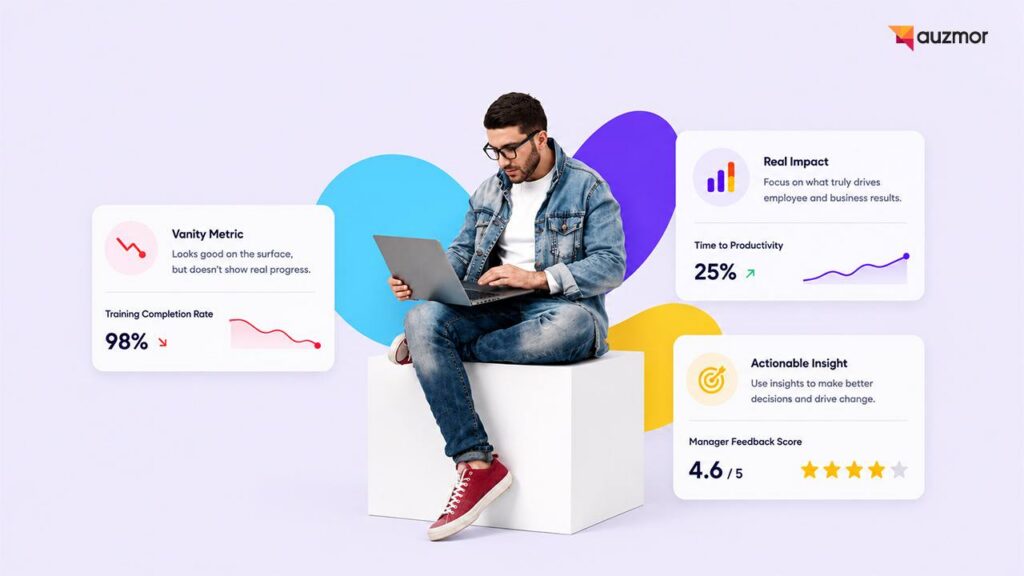
You have probably sat through this exact presentation. A learning and development leader stands up during a quarterly business review. They point to a brightly colored chart on the screen and proudly announce that ninety five percent of the company completed the new cybersecurity module. They follow that up by stating the entire sales team finished the annual product training. Everyone in the room nods. The executives smile. But nobody asks the one question that actually matters. Did anyone actually learn anything? If your customer success team finishes a communication workshop but their ticket resolution time stays exactly the same, that training was a waste of company time. If your sales representatives click through an entire enablement course but their quota attainment remains completely flat, your learning program is failing. You are just rubber stamping attendance. Business leaders need absolute proof that training improves employee performance. They need to see how it limits risk, enhances the customer experience, and drives new revenue. To get that proof, you have to fundamentally change your approach. You must learn how to measure LMS success beyond completion rate.


The Trap of the Perfect Completion Rate

Let us be completely honest about why companies rely on completion rates. It is an incredibly easy number to find. Most basic software platforms put that metric right on the home screen. It gives everyone a false sense of security. A completion rate is a perfectly fine baseline metric. You absolutely need to know if your employees can log into the system. You need to know if the videos load properly. For legal and compliance reasons, you must have a record showing that an employee viewed a specific safety policy. But a perfect completion rate can easily hide a completely broken training program. A high percentage just means people opened a window on their computer. It means they clicked the "next" button a few times. It might mean they guessed "C" on every single multiple choice question until the system let them pass. Relying on attendance data turns employee training effectiveness into an administrative chore. Employees feel annoyed because they are forced to take time away from their actual jobs to watch a generic video. Management feels satisfied because they checked a box for the quarter. Meanwhile, the actual skills gap within your workforce remains exactly the same. Your people did not get better at their jobs.

Learning from the Kirkpatrick Approach

If you want to measure actual outcomes, you should look at how the experts evaluate corporate learning. The Kirkpatrick Evaluation Model is a famous standard in the human resources world. It forces leaders to look past attendance and evaluate learning across four distinct levels. Level one evaluates the immediate reaction. Did the employees actually find the course useful to their daily jobs, or did they think it was a waste of time? Level two looks at the actual learning. Did they absorb the knowledge? You usually test this with a quiz right after the session ends. Level three looks at behavior change. Are your employees doing their jobs differently three months after the class ended? Level four looks at business results. Did the company make more money, save more time, or lose fewer customers because of this initiative? Modern business founders, operations leaders, and HR professionals must focus their energy on levels three and four. You have to shift the boardroom conversation. Stop asking if people took the course. Start asking if they used what they learned.

The Core Business Metrics You Must Track

When you stop looking at vanity metrics, you can start tracking the data that the executive team actually cares about. Here is what real learning analytics look like in a modern business environment.

Time to Proficiency and Productivity

This is arguably the most important metric for any growing company. How fast can a brand new hire start contributing to the bottom line? Think about your sales team. If your standard onboarding program historically takes ninety days for a new representative to close their first deal, that is your baseline. If you launch a new training initiative and that number drops to sixty days, you have massive, undeniable proof of training ROI. You just gave the company a month of extra revenue per new hire.

Skill Application on the Job

Acquiring knowledge is useless if an employee never applies it to their daily workflow. Leaders need a way to track how well team members translate abstract concepts into tangible tasks. This is where you look at the benefits of skill mapping within your organization. A good skill map lets a manager formally evaluate whether an employee can execute a newly learned process completely independently, without needing someone to hold their hand.

Behavior Change and Manager Observation

If a mid-level manager completes an eight week course on conflict resolution, how do you know it worked? You look at their team. Do the direct reports indicate a better working environment in the next quarterly engagement survey? Do turnover rates on that specific team drop? Behavior change is the actual bridge between a finished course and a business result. It requires you to look at how people operate on the floor after the training ends.

Retention and Internal Career Growth

Employees leave companies when they feel stuck. According to the Workplace Learning Report published by LinkedIn Learning, companies that excel at internal mobility keep their employees significantly longer than companies that do not. You should track how many of your employees earn promotions or make lateral department moves after finishing your internal development programs. Proving that your training creates future leaders is the best way to secure your L&D budget.

Customer Facing Outcomes

You must connect your training data directly to your customer satisfaction metrics. Let us say your support team takes a rigorous course on customer de-escalation and empathy. You need to track the impact of that specific course on your net promoter scores. You need to look at ticket resolution times over the next ninety days. If the scores go up and the resolution times go down, your training was a success.

Compliance Readiness and Risk Reduction

For industries like manufacturing or healthcare, finishing a safety course is required by law. But true business success means being totally audit ready at any given second. According to the Society for Human Resource Management, effective compliance training must go beyond mere completion. Success means looking at your incident reports. Did the number of safety accidents on the warehouse floor decrease? Did your IT team catch more phishing attempts because the security training actually changed how employees read their emails?

Building a Practical Measurement Strategy

Knowing exactly what to measure is a great start. But you also need a realistic way to capture this information. You cannot ask your operations team to spend forty hours a week manually cross referencing spreadsheets. You need a practical playbook. You have to start by establishing a baseline. You cannot prove that an employee grew if you have no idea where they started. Give them a pre-assessment before the training begins. Give them a post-assessment when it ends. Next, you must build manager feedback loops into your normal monthly workflow. Do not make this complicated. Have managers fill out a simple three question rubric thirty days after a major training event. Ask the manager if they have personally observed the employee using the new skills. You also need to follow up with the learners themselves. Do not just survey them on the day the course ends. Send an automated survey six weeks later. Ask them if they are actively using the material. More importantly, ask them what internal barriers are preventing them from using the material. Sometimes the training is perfect, but a broken company process stops the employee from applying it. This is where you have to correlate your learning data with your actual department KPIs. If you want to know if your enablement program worked, you need to track employee training using LMS reports and compare that data directly against your Salesforce or HubSpot dashboards. Put the assessment scores right next to the win rates. The truth will be incredibly obvious.

What Good Measurement Looks Like by Industry

A generic approach to learning measurement will fail. A hospital does not measure success the same way a software startup does. You have to tailor your metrics to your specific business model. If you operate a B2B company, your ultimate goals are usually faster sales cycles, deeper product adoption, and higher contract renewals. A B2B sales leader should measure whether the specific representatives who passed a high level negotiation course have lower discount averages than the people who failed it. A customer enablement leader needs to see if the clients who completed the digital onboarding modules submit fewer support tickets than the clients who skipped the onboarding entirely. If you operate a B2C company, your world revolves around volume, speed, and frontline consistency. Retail executives need to know if their seasonal holiday hires are hitting full register productivity in their first five days on the job. Customer support directors must measure if a newly launched service protocol directly impacts first call resolution metrics. For massive franchise businesses, success is all about brand consistency. The Association for Talent Development frequently highlights how top retail brands correlate their local franchise training data directly with their regional secret shopper scores.

The Role of Your Tech Stack

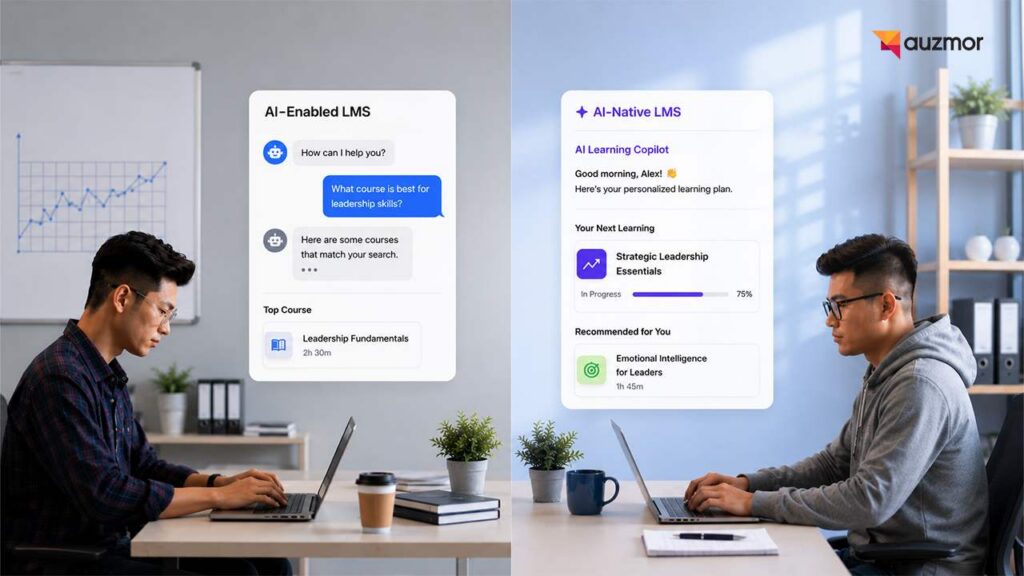
You simply cannot measure long term behavior change and direct business impact using outdated software. If your current platform only exists to host videos and print out PDF certificates, you are going to struggle. Modern organizations require technology that helps leaders understand exactly what is working and where learners are failing. This is where a modern platform like Auzmor LMS changes the equation. You need a system that supports your business goals rather than just acting as a digital filing cabinet. Auzmor helps HR and L&D leaders move past basic attendance tracking by providing incredibly deep AI-powered learning analytics. These analytics allow you to see the exact correlation between skill acquisition and daily performance. When your platform handles the heavy lifting, your team gets their time back. By using LMS administration time with AI automation, managers do not have to chase people down to finish their modules. Instead, those managers can spend their time actually coaching their employees on the floor. Auzmor acts as your central operational hub, making it remarkably easy to prove the ROI of your training budget to your CEO.

Common Data Mistakes You Must Avoid

Even highly experienced leaders make basic mistakes when they try to upgrade their measurement strategies. The most common error is measuring way too soon. Changing human behavior takes a significant amount of time. If you try to evaluate the business impact of a complex leadership communication course the morning after it ends, you are only capturing a temporary emotional high. You are not capturing real improvement. You have to wait thirty to sixty days to see if those new habits actually survived the stress of the daily grind. Another massive mistake is tracking too many random numbers. Do not build a dashboard with fifty different metrics just because the software allows it. If a specific metric does not directly inform a business decision or highlight a clear performance gap, stop tracking it. It is just noise. Finally, never ignore your frontline managers. Your managers are the people who actually observe the daily habits of your workforce. They are the ones who enforce the new standards. If you leave them out of your evaluation process, you are cutting off your most valuable source of qualitative data. Corporate training must be an ongoing process supported by local leadership, not an isolated event hosted by the HR department.

The Final Word on Learning Impact

The era of justifying your corporate learning budget with a basic attendance sheet is completely over. Executives now expect human resources and enablement initiatives to drive the exact same measurable value as the marketing and product teams. By focusing heavily on concrete performance data, observable behavioral shifts, and bottom line financial results, you can build a highly effective training culture that actually moves the needle for your company. Evaluating LMS success beyond completion rate requires a serious mindset shift. It also requires the right technology to back it up. Ultimately, the real question is never whether your employees managed to finish the course. The only question that matters is whether your company got better because of it. Explore how a modern LMS can help you measure learning in terms leaders actually care about.

Menu

Compliance training

Become audit-ready

Employee development

Compliance

Sell Training

Customer training

Partner training

training online lms

An all-in-one LMS

Content

Content Marketplace

Custom Content

Auzmor Learn

Get people hooked to learning

Auzmor Office

Unforgettable employee experience

Auzmor LXP

Tailored learning experience

Auzmor Learn

Get people hooked to learning

Content creation

Social learning

Blended learning

Reporting & insights

Mobile app

Extended enterprise

Checklists

E-commerce

Blog

Case studies

White papers

Discover top trends to facilitate smarter business practices

About

Careers

Contact

Support

join auzmor team

Join an innovative team

E-Learning Content

Content Marketplace

Custom Content

Public Sector

On-Premise

Auzmor K12

Auzmor Higher Education